What Are the Basic Controls of a Forklift Explained
Understanding the basic controls of a forklift is essential for safe and efficient operation. This guide walks you through every major control on a lift truck, from the ignition and dashboard to the hydraulic levers and directional levers. Whether you are a new operator or refreshing your knowledge, you will learn how each control works and why it matters for forklift safety.
If you have ever walked past a warehouse and watched a forklift glide effortlessly between aisles, you might have wondered how all those controls actually work. The truth is, what are the basic controls of a forklift is a question every new operator should ask before turning that key. A forklift is not like driving a car. It handles differently, steers from the rear, and carries heavy loads that can become dangerous if you do not know what you are doing.
This guide breaks down every major control on a standard counterbalance forklift. We will walk you through the dashboard, the pedals, the mast, the directional lever, and all the safety features that keep operators safe on the job. By the end, you will have a clear picture of how a lift truck works and why knowing these basics matters so much.
Forklift operation is a skill that combines knowledge, practice, and respect for the equipment. Whether you work in a warehouse, a construction site, or a shipping dock, understanding your machine is the first step toward doing your job well. So let us dive right in and explore every control you will find in the operator compartment.
Key Takeaways
- The ignition, dashboard, and steering column form the foundation of forklift operation.
- The three pedals (accelerator, brake, and inching pedal) control movement and speed.
- Mast controls use hydraulic levers to raise, lower, and tilt the forks.
- The directional lever lets you move forward or reverse with precision.
- Safety features like the horn, parking brake, and overhead guard protect the operator.
- Pre-operation checks are critical for preventing accidents and equipment damage.
- Proper forklift training and certification are required in most workplaces.
📑 Table of Contents
Understanding the Forklift Control Layout
Before you start any forklift, you need to know where everything is. The control layout might look overwhelming at first, but it becomes second nature once you understand the purpose of each piece. Every forklift model has a similar arrangement, even if the exact placement varies slightly.
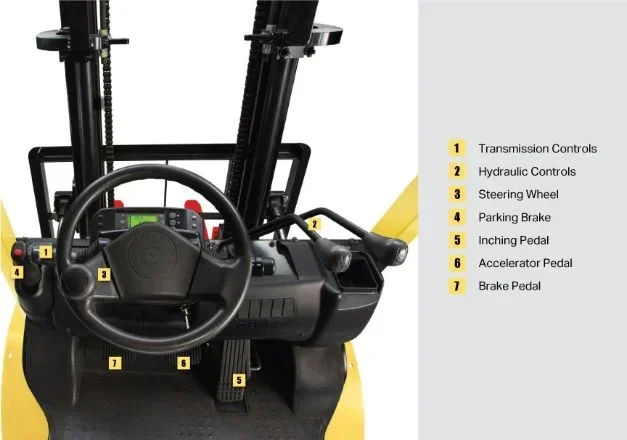
The main areas you will interact with include the ignition system, the dashboard panel, the steering column, and the floor-mounted controls. Each one plays a specific role in making the forklift move, lift, and stop safely. Let us break them down one by one.
The Ignition and Dashboard
The ignition switch is where everything begins. Just like starting a car, you insert the key and turn it to power up the forklift. The dashboard then lights up with warning indicators and gauges that tell you the machine is ready to go.
The dashboard typically includes:
- Fuel or battery gauge — shows how much power remains
- Speedometer — displays your current travel speed
- Hour meter — tracks total operating hours for maintenance
- Warning lights — alert you to low oil, high temperature, or system faults
- Load capacity chart — often displayed on the dashboard or nearby, showing the maximum weight the forklift can safely carry at different load centers
Before you move the forklift, glance at the dashboard. Make sure all lights are normal and there are no warning signals. This simple habit can prevent a lot of trouble later. A well-maintained forklift dashboard gives you confidence that the machine is working as it should.
The Steering Column and Steering Wheel
The steering column holds the steering wheel, and it is one of the most important parts of the forklift. But here is something many beginners do not expect: forklifts steer from the rear axle, not the front wheels.
This means the back end of the machine swings wide when you turn. It is a key reason why forklift training always emphasizes slow, careful turning. The steering wheel controls the rear wheels, and the turning radius can be surprisingly tight. This design gives the forklift excellent maneuverability in tight warehouse spaces.
Always grip the steering wheel firmly with both hands. Sudden jerky movements can cause the forklift to become unstable, especially when carrying a load. Smooth, controlled steering is the hallmark of a skilled operator.
The Accelerator and Brake Pedals
Once the forklift is running and you are seated comfortably, your feet take over. The floor beneath the operator seat contains the pedals that control movement, speed, and stopping. Understanding how these forklift pedals work is absolutely essential for safe forklift operation.
Most standard forklifts have three pedals, though some models have only two. Let us look at what each one does.
Understanding the Three Pedals
The three pedals on a forklift, from left to right, are typically the inching pedal, the brake pedal, and the accelerator pedal. Here is what each one does:
- Inching Pedal (Left): This pedal disengages the transmission and allows you to control the forklift’s speed without using the accelerator. You use it when you need precise movement, especially when lifting or stacking loads. Pressing the inching pedal also activates the brake, which helps you slow down smoothly.
- Brake Pedal (Middle): This pedal slows the forklift down and brings it to a complete stop. Always press the brake gently and progressively. Slamming on the brake with a loaded forklift can cause the load to shift or the machine to tip.
- Accelerator Pedal (Right): This pedal increases the forklift’s speed. Use it sparingly, especially indoors or on uneven surfaces. The forklift is not designed for high speed, and pushing the accelerator too hard can lead to loss of control.
Some forklifts use a hand lever instead of an inching pedal. The function is the same — it lets you slow down and control your speed with precision. If you are not sure which type your forklift has, ask your supervisor before operating it.
Common Pedal Mistakes to Avoid
New operators often make a few common mistakes with the pedals. Here are some to watch out for:
- Confusing the inching pedal with the brake. Always know which pedal is which before you start moving.
- Resting your foot on the accelerator while driving. This can cause sudden, unintended acceleration.
- Braking too hard on a slope. This can shift the load forward or cause the forklift to slide.
- Using only one foot for both pedals. Use your right foot for the accelerator and brake, and your left foot for the inching pedal if your forklift has one.
Getting the pedals right takes practice. Spend time in a safe, open area before you start working with heavy loads. The more comfortable you become with the forklift pedals, the more confident and safe you will be.
Mast and Lift Controls
The mast is the tall vertical assembly at the front of the forklift that raises and lowers the forks. The mast controls let you manage the hydraulic system that moves the forks up and down and tilts the load backward or forward. These are some of the most frequently used controls on any lift truck.
Understanding mast controls is critical because most forklift accidents happen during lifting and stacking operations. The more you know about how the hydraulic system works, the safer you will be.
The Hydraulic Lever
The hydraulic lever, sometimes called the lift lever, controls the up-and-down movement of the forks. When you push the lever forward, the forks rise. When you pull it back, the forks lower.
A few important things to remember:
- Always check the load capacity before lifting. Every forklift has a rated maximum weight, and exceeding it is extremely dangerous.
- Lift the load only as high as needed for the task. Higher loads raise the center of gravity and make the forklift less stable.
- Keep the forks low when traveling. A general rule is to keep the forks 4 to 6 inches above the ground.
- Never raise a load while the forklift is moving, unless absolutely necessary and the path is clear.
The hydraulic system uses pressurized fluid to create smooth, powerful movement. Over time, you will learn how much pressure to apply for different tasks. Start slow and build up your confidence gradually.
Tilt Control
The tilt lever controls the angle of the mast and forks. This is what lets you tilt the load backward to keep it stable during transport. Most loads should be tilted slightly backward when lifted off the ground.
Tilt control works like this:
- Tilt backward: Leans the load toward the forklift, which keeps it secure during travel
- Tilt forward: Leans the load away from the forklift, which is useful when placing a load on a shelf or rack
Use the tilt lever gently. Abrupt tilting can cause the load to shift or fall. When stacking, always tilt the load forward slightly before lowering it into place, then tilt it back to secure it.
Fork Adjustment
Some forklifts allow you to adjust the spacing between the forks. This is helpful when you need to handle loads of different widths. The fork adjustment control is usually a side lever or a hydraulic mechanism that slides the forks apart or together.
Always make sure the forks are evenly spaced and securely locked before lifting a load. Uneven fork placement can cause the load to slide off to one side, which is a serious safety hazard.
Directional and Travel Controls
Once you can start, stop, and lift, the next thing you need to master is moving the forklift in the right direction. The directional lever and travel controls let you go forward, reverse, and navigate tight spaces with confidence.
The Directional Lever
The directional lever, also called the shift lever, controls whether the forklift moves forward or in reverse. It is usually located between the seat and the mast or on the floor to the left of the operator.
Here is how it typically works:
- Neutral position: The forklift is not moving in either direction. This is your starting position before shifting.
- Forward position: Engages forward motion. Use this when driving down aisles or moving loads to a destination.
- Reverse position: Engages reverse motion. Use this when backing up or returning to the starting point.
Always come to a complete stop before shifting from forward to reverse or vice versa. Shifting while the forklift is still moving can damage the transmission and create a safety risk.
Speed Management and Travel Safety
Forklifts are not built for speed. Most models operate at a maximum of 5 to 8 miles per hour, and even less when carrying a load. Speed management is a big part of forklift safety.
Follow these travel safety tips:
- Slow down on turns, slopes, and wet or uneven surfaces
- Sound the horn at intersections and blind corners
- Keep the load low to the ground while traveling
- Never exceed the rated load capacity
- Keep a safe following distance from other forklifts and pedestrians
The load center also affects how the forklift handles during travel. The load center is the distance from the face of the forks to the center of gravity of the load. If the load is off-center, the forklift can become unstable. Always position the load as close to the mast as possible for the best balance.
Safety Features and Pre-Operation Checks
Forklift safety is not just about knowing the controls — it is also about using the safety features built into the machine. Every forklift comes with systems designed to protect the operator and those working nearby. Ignoring these features is one of the leading causes of workplace accidents.
The Horn and Warning Systems
The horn button is one of the simplest but most important controls on a forklift. You should use it whenever you are approaching a corner, an intersection, a doorway, or a pedestrian. A quick beep lets others know you are nearby.
Many modern forklifts also have flashing lights, beepers, and backup alarms. These warning systems are not optional extras — they are essential safety tools. Make sure they are working before you start your shift.
The Parking Brake and Emergency Stops
The parking brake is a lever or pedal that locks the forklift in place when it is not in use. Always engage the parking brake when you leave the operator seat, even for a moment.
Some forklifts also have an emergency stop button, usually a large red button on the dashboard or steering column. This button cuts power to the engine or motor instantly. You should know exactly where it is before you start operating the forklift.
The Overhead Guard
The overhead guard is the metal frame that surrounds the operator compartment. It is designed to protect you from falling objects. While it provides some protection, it is not a substitute for safe operating practices. Never place your hands or any body part outside the overhead guard while the forklift is running.
Tips for New Forklift Operators
If you are new to forklift operation, the controls might feel like a lot to remember at first. That is completely normal. The key is to take it one step at a time and build your confidence gradually.
Getting Comfortable with the Controls
Start by sitting in the operator seat and familiarizing yourself with every control before you turn the key. Point to each one and say what it does. This simple exercise helps build muscle memory and reduces the chance of mistakes during actual operation.
Next, practice in an empty, flat area. Try starting the forklift, moving forward and backward, turning, and using the mast controls — all without carrying a load. Once you feel comfortable with the empty forklift, you can gradually start working with lighter loads and build up from there.
The Importance of Forklift Training and Certification
In most countries, forklift training and certification are legally required before you can operate a lift truck on the job. These programs teach you the controls, the safety rules, and the best practices for handling different types of loads.
Forklift training is not a one-time event. Refresher courses should be taken regularly — usually every three years — to keep your skills sharp and your knowledge up to date. Even experienced operators benefit from periodic refreshers, especially when working with new types of forklifts or in new environments.
If your employer offers training, take full advantage of it. If not, consider enrolling in a certified forklift training program on your own. The investment in your safety and skills is always worth it.
Maintaining Your Forklift for Peak Performance
A well-maintained forklift responds better to controls and is safer to operate. Before every shift, perform a quick pre-operation inspection. Check the tires, the hydraulic fluid, the brakes, the horn, and the lights. Report any issues to your supervisor immediately.
Regular maintenance also extends the life of your forklift. This includes checking the counterweight, inspecting the forks for cracks or bends, and ensuring the mast chains are properly tensioned. A little care goes a long way in keeping your machine running smoothly.
Understanding the basic controls of a forklift is just the beginning. The more you practice and learn, the more confident and competent you will become. Treat every shift as an opportunity to sharpen your skills and stay safe on the job.
Conclusion
The basic controls of a forklift cover everything from the ignition and dashboard to the pedals, mast levers, and safety features. Each control has a specific purpose, and understanding how they all work together is what makes a forklift operator truly effective.
Remember that forklift operation is a skill that improves with practice and ongoing training. Always respect the machine, follow the safety rules, and never hesitate to ask questions if something is unclear. The controls might seem simple on the surface, but mastering them takes time, patience, and a genuine commitment to safety.
Whether you are just starting out or looking to refresh your knowledge, this guide gives you a solid foundation. Apply what you have learned, stay curious, and always put safety first. That is the best way to become a skilled and confident forklift operator.
Frequently Asked Questions
What are the three main pedals on a forklift?
The three main pedals are the inching pedal on the left, the brake pedal in the middle, and the accelerator pedal on the right. The inching pedal disengages the transmission for precise control, the brake slows or stops the forklift, and the accelerator increases speed. Always use the correct foot for each pedal to avoid confusion.
How do you raise and lower the forks on a forklift?
You use the hydraulic lever, also called the lift lever, to raise and lower the forks. Pushing the lever forward raises the forks, and pulling it back lowers them. Always keep the forks low while traveling and only raise them as high as needed for the task at hand.
Why does a forklift steer from the rear?
Forklifts steer from the rear because the rear wheels turn, which gives the machine a tight turning radius. This design is great for maneuvering in narrow warehouse aisles, but it also means the back end swings wide. New operators need to be especially careful when turning to avoid hitting obstacles or pedestrians.
What is the load capacity of a forklift?
The load capacity is the maximum weight a forklift can safely carry at a specific load center. This information is displayed on the forklift data plate, usually near the dashboard. Never exceed the rated capacity, as doing so can cause the forklift to tip over or lose stability.
Is forklift training required before operating a lift truck?
Yes, in most countries, formal forklift training and certification are legally required before operating a forklift on the job. Training covers the controls, safety procedures, and proper handling techniques. Refresher courses are recommended every three years to keep skills current.
What should you check before starting a forklift?
Before starting, check the dashboard for warning lights, inspect the tires and forks, test the horn and brakes, verify the hydraulic fluid level, and ensure the parking brake works. This pre-operation inspection helps catch problems early and keeps you safe throughout your shift.