How Bugattis Quad-Turbo Tech Achieves Unmatched Speed
Bugatti’s quad-turbo system uses four turbochargers to force massive amounts of air into its W16 engine, creating insane horsepower and torque. This forced induction setup is the core reason Bugatti supercars hit speeds over 250 mph. Understanding this technology helps car enthusiasts appreciate the incredible engineering behind the world’s fastest production cars.
Bugatti has built a reputation for making the fastest cars on Earth. When you think about what makes these machines so incredibly quick, the answer comes down to one thing: quad-turbo technology. Four turbochargers working in perfect harmony push air into the engine with such force that the result is mind-blowing acceleration and top speeds that defy belief.
Whether you are a car enthusiast or just curious about what makes supercars tick, understanding Bugatti quad-turbo engineering is fascinating. This article breaks down exactly how four turbochargers transform a massive engine into a speed machine. We will explore the W16 engine layout, the science of forced induction, and why this setup remains unmatched in the automotive world.
Key Takeaways
- Quad-Turbo Design: Four turbochargers work together to eliminate lag and deliver smooth, massive power across the entire RPM range.
- W16 Engine Architecture: The unique 16-cylinder layout allows for compact packaging while producing over 1,500 horsepower.
- Advanced Materials: Heat-resistant alloys and ceramics handle the extreme temperatures generated by quad-turbo combustion.
- Aerodynamic Integration: The turbo system works hand-in-hand with the car’s body design to maximize downforce and reduce drag.
- Precision Engineering: Each turbocharger is calibrated to exact specifications for optimal boost pressure and response.
📑 Table of Contents
- What Is Quad-Turbo Technology?
- The Heart of the System: The W16 Engine
- The Science Behind Forced Induction
- Advanced Materials and Thermal Management
- Engineering Precision and Calibration
- How Quad-Turbo Tech Compares to Other Systems
- Real-World Performance and Driving Experience
- Maintenance and Care of Quad-Turbo Systems
- The Future of Turbocharging Technology
- Conclusion
What Is Quad-Turbo Technology?
Quad-turbo means exactly what it sounds like: four turbochargers working together in one engine. Each turbocharger uses exhaust gases to spin a compressor that pushes extra air into the combustion chambers. More air means more fuel can be burned, which equals more power.
Most cars use either no turbochargers or just one. A single turbo works well for many vehicles, but it has limits. When you need enormous power from a large engine, one turbo simply cannot keep up. That is where the quad setup shines.
Why Four Turbochargers Instead of One Big One?
You might wonder why Bugatti does not just use one massive turbocharger. The answer comes down to response time and efficiency. A single large turbo creates something called “turbo lag.” That is the delay between pressing the gas pedal and feeling the power kick in.
With four smaller turbochargers, each one spools up faster. This means the power delivery feels almost instantaneous. The driver gets smooth, consistent boost across the entire rev range. For a car that can go from 0 to 60 in under 2.5 seconds, this responsiveness is absolutely critical.
Also, splitting the work among four turbochargers reduces the stress on each individual unit. This leads to better reliability and longer component life, even under extreme performance conditions.
The Heart of the System: The W16 Engine
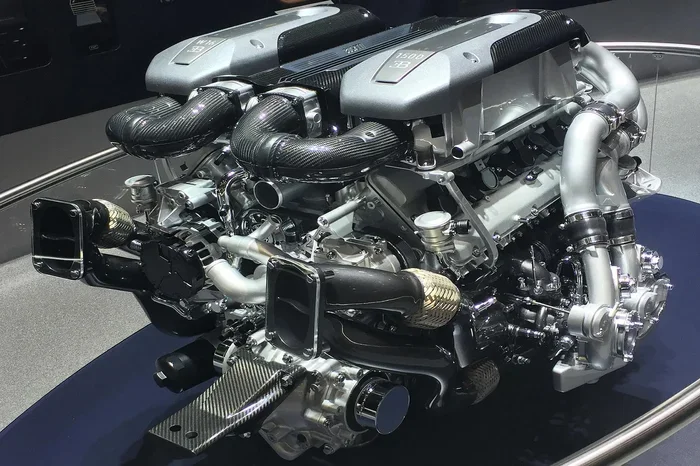
Bugatti’s quad-turbo system would not mean much without its legendary W16 engine. This engine is unlike anything else on the market. It has 16 cylinders arranged in a unique W shape, which allows engineers to fit a massive engine into a relatively compact space.
The W16 engine sits in the heart of models like the Bugatti Chiron and the Bugatti Bolide. These engines displace over 8 liters and produce upwards of 1,500 horsepower. That kind of power output is only possible thanks to the quad-turbo setup feeding it a steady stream of compressed air.
How the W16 Layout Works
The W16 engine uses two cylinder banks on each side, with each bank containing four cylinders arranged in a narrow V. Two narrow-angle VR8 engines are joined at a common crankshaft to form the W shape. This compact design allows for four turbochargers to be positioned symmetrically around the engine.
Each pair of turbochargers feeds a set of cylinders. This balanced arrangement ensures even power delivery and thermal distribution. The result is an engine that produces incredible horsepower while remaining structurally sound under extreme stress.
Turbocharged performance at this level requires precision engineering down to the smallest detail. Every component, from the pistons to the exhaust valves, is designed to handle temperatures and pressures that would destroy a standard engine.
The Science Behind Forced Induction
Forced induction is the process of pushing more air into an engine than it would normally draw in on its own. A naturally aspirated engine relies on atmospheric pressure to fill its cylinders. A turbocharged engine uses energy from exhaust gases to compress incoming air, packing more oxygen molecules into each cylinder.
More oxygen means the engine can burn more fuel per combustion cycle. More fuel burned means more energy released, which translates directly into more horsepower and torque. This is the fundamental principle that makes quad-turbo tech so effective.
Boost Pressure and Its Role
Boost pressure measures how much extra air the turbochargers push into the engine. Bugatti’s system operates at carefully calibrated boost levels that maximize power without pushing the engine past its limits.
Too much boost pressure can cause dangerous conditions like detonation or pre-ignition. Too little boost means wasted potential. Bugatti’s engineers have spent years fine-tuning the boost pressure curves for each turbocharger to hit the perfect sweet spot.
The four turbochargers also work together to maintain consistent boost across different driving conditions. Whether you are cruising on the highway or launching from a standstill, the system adjusts to deliver smooth, predictable power every time.
Advanced Materials and Thermal Management
Generating 1,500 horsepower creates an enormous amount of heat. If that heat is not managed properly, engine components can fail quickly. Bugatti addresses this challenge through advanced materials and sophisticated cooling systems.
The turbocharger housings are made from high-grade alloys that can withstand extreme temperatures. Ceramic components are used in some areas to reduce heat transfer and keep the compressor side cool. These materials are essential for maintaining consistent turbocharging technology performance over extended periods of hard driving.
Intercooling Systems
When air is compressed by a turbocharger, it heats up significantly. Hot air is less dense, which means it carries less oxygen. To combat this, Bugatti uses large, high-efficiency intercoolers that cool the compressed air before it enters the engine.
Cooler, denser air means more oxygen molecules per intake stroke. More oxygen means more complete combustion and more power. The intercooling system is a critical part of the overall forced induction setup, and Bugatti’s engineers have optimized every aspect of it for maximum efficiency.
The cooling system also includes dedicated circuits for the turbocharger bearings and other critical components. This multi-layered approach to thermal management is what allows Bugatti engines to sustain extreme power outputs without overheating.
Engineering Precision and Calibration
What truly sets Bugatti apart is not just the hardware but the software and calibration that governs it. Each turbocharger is precisely tuned to work in harmony with the other three. The engine control unit, or ECU, monitors dozens of sensors in real time and adjusts fuel delivery, ignition timing, and boost pressure on the fly.
This level of engine tuning precision is what makes the quad-turbo system feel so seamless. The driver experiences smooth, linear power delivery rather than sudden surges or flat spots. Every input from the throttle pedal translates into immediate, predictable response.
Variable Geometry and Modern Innovations
Modern Bugatti turbochargers incorporate variable geometry technology. This means the internal vanes inside the turbocharger can adjust their angle to optimize airflow at different engine speeds. At low RPMs, the vanes create a smaller, more efficient path for exhaust gases. At high RPMs, they open up to allow maximum airflow.
This adaptive approach eliminates much of the traditional turbo lag that plagued older designs. The result is an engine that feels responsive and eager across the entire rev range, from low-speed cruising to full-throttle acceleration.
Bugatti also uses advanced materials in the turbine wheels themselves. Lightweight alloys allow the turbocharger wheels to spin up to speed quickly, further reducing response time. These small but critical design choices add up to a system that feels instantaneous and effortless.
How Quad-Turbo Tech Compares to Other Systems
To truly appreciate Bugatti’s quad-turbo approach, it helps to compare it with other turbocharging methods used in the automotive industry. Different setups offer different trade-offs in terms of power, response, and complexity.
| Turbo Setup | Typical Power Range | Response Time | Complexity |
|---|---|---|---|
| Single Turbo | 300-600 HP | Moderate Lag | Low |
| Twin Turbo (V-Config) | 500-800 HP | Low Lag | Medium |
| Twin Turbo (Parallel) | 600-1,000 HP | Low Lag | Medium-High |
| Quad Turbo | 1,000-1,500+ HP | Minimal Lag | Very High |
As you can see, the quad-turbo setup is at the top of the power and complexity scales. Most production cars do not need this level of forced induction. But for a company like Bugatti, where the goal is to build the fastest, most powerful production cars in the world, the quad-turbo approach is the only viable option.
For comparison, a car like the Dodge Charger gets impressive speed thanks to its supercharged V8, but it produces far less power than a Bugatti. You can read about how fast a Dodge Charger GT goes to understand the difference that forced induction technology makes at the extreme end of the spectrum. Similarly, understanding how many fuel pumps a Dodge Charger has gives you a sense of the simpler fuel delivery systems used in high-performance American muscle cars.
Why Quad-Turbo Remains Unmatched
The quad-turbo configuration offers a unique combination of benefits that no other setup can match at the highest performance levels. The four-turbo arrangement provides near-instantaneous response, enormous power capacity, and excellent thermal management. Each turbocharger handles a portion of the engine’s exhaust flow, which keeps them operating in their optimal efficiency range at all times.
This technology has pushed the boundaries of what is possible in a production car. Bugatti’s top speeds and acceleration records stand as a testament to the effectiveness of the quad-turbo approach. While other manufacturers have experimented with different configurations, none have achieved the same level of sustained, reliable extreme performance.
When you compare this to the engineering in more mainstream vehicles, the difference is staggering. Even a well-tuned car like the Dodge Challenger, which delivers impressive miles per gallon and strong acceleration, operates in an entirely different performance tier than a quad-turbo Bugatti. The gap in automotive engineering philosophy is clear when you look at the power figures and the technology involved.
Real-World Performance and Driving Experience
So what does all this engineering mean for the person behind the wheel? The experience of driving a Bugatti with quad-turbo power is unlike anything else on the road. The acceleration is smooth but relentless. The top speed capabilities are staggering. And the overall driving experience feels polished and refined despite the raw power on offer.
Bugatti engineers have worked hard to make sure the quad-turbo system does not just produce numbers on a spec sheet. They have focused on making the power delivery feel natural and usable in real-world driving conditions. This means the car is not just fast in a straight line but also responsive and engaging during everyday driving.
Acceleration and Top Speed
The numbers speak for themselves. Bugatti models with quad-turbo W16 engines can accelerate from 0 to 60 mph in around 2.3 to 2.5 seconds. Top speeds exceed 260 mph in some configurations. These figures place Bugatti firmly at the top of the supercar hierarchy.
What makes these numbers even more impressive is how smoothly they are achieved. There is no harsh surge or sudden spike in power. The four turbochargers deliver boost progressively, building speed in a way that feels controlled and predictable even at extreme velocities.
For those interested in how other high-performance vehicles stack up, you might explore how fast a Dodge Charger can go to see the contrast in top speed capabilities. The engineering differences between a quad-turbo hypercar and a muscle car are vast, but both represent incredible achievements in their respective segments.
Maintenance and Care of Quad-Turbo Systems
Owning a car with this level of performance comes with responsibilities. The quad-turbo system requires regular maintenance to keep it operating at peak efficiency. This includes checking the turbocharger bearings, inspecting the intercooler lines, and ensuring the boost pressure sensors are functioning correctly.
One often overlooked aspect of turbo maintenance is monitoring for oil leaks around the turbo housings. Since the turbochargers spin at extremely high speeds, any oil leakage can lead to bearing damage and reduced performance. Regular inspections by qualified technicians are essential.
If you ever notice unusual behavior from your turbocharged vehicle, such as warning lights on the dashboard, it is important to address the issue promptly. Sometimes engine codes related to boost pressure or turbo performance can be cleared manually to reset the system. Learning how to manually clear your car codes can be a useful first step before visiting a mechanic. However, persistent issues should always be diagnosed by a professional.
Tips for Long-Term Turbo Health
- Allow the engine to warm up before pushing it to full power. Cold turbochargers are more susceptible to damage.
- Let the engine cool down after hard driving before turning it off. This allows the turbocharger bearings to properly lubricate.
- Use high-quality synthetic oil that is rated for high-temperature performance.
- Check the intercooler regularly for leaks or blockages that could reduce cooling efficiency.
- Follow the manufacturer’s service schedule for turbo-specific inspections and replacements.
Taking care of the quad-turbo system ensures that the engine continues to deliver its incredible power output for years to come. Neglecting maintenance can lead to costly repairs and diminished performance over time.
The Future of Turbocharging Technology
Bugatti continues to push the boundaries of what turbocharging technology can achieve. New materials, smarter electronic controls, and advanced manufacturing techniques are making each generation of turbochargers more efficient and capable than the last.
Electric turbochargers are one area of active development. These systems use an electric motor to spin the compressor, eliminating turbo lag entirely. While Bugatti has not yet adopted this technology in production models, it represents an exciting direction for the future of high-performance forced induction.
The principles behind quad-turbo tech will continue to influence automotive engineering for decades to come. As manufacturers seek to extract more power from smaller, more efficient engines, the lessons learned from Bugatti’s approach to forced induction will remain relevant and inspiring.
The automotive world is always evolving, but the fundamental physics of turbocharging remain the same. More compressed air means more power. And Bugatti’s quad-turbo system remains the gold standard for delivering that compressed air with precision, reliability, and sheer force.
Conclusion
Bugatti’s quad-turbo technology represents the pinnacle of automotive forced induction engineering. Four turbochargers working in concert with the W16 engine produce power levels that were once thought impossible for a production car. From the advanced materials that handle extreme heat to the precision calibration that delivers smooth, instant response, every aspect of this system is designed for one purpose: unmatched speed.
The quad-turbo tech that powers Bugatti supercars is more than just an engineering feat. It is a statement about what is possible when visionary engineers push the limits of physics and chemistry. The result is a driving experience that is truly unlike anything else on Earth.
Whether you are a seasoned car enthusiast or someone who simply marvels at the fastest machines on the planet, understanding how Bugatti’s quad-turbo system works gives you a deeper appreciation for the incredible engineering that goes into building these extraordinary vehicles. The next time you see a Bugatti screaming down the highway, you will know exactly what is making it go so fast.
Frequently Asked Questions
What makes Bugatti’s quad-turbo system different from a single turbo setup?
A single turbocharger uses one compressor to force air into the engine, which can cause lag at low RPMs. Bugatti’s quad-turbo system uses four smaller turbochargers that each spool up faster, eliminating lag and delivering smooth, immediate power across the entire RPM range. This setup also allows the system to handle much higher power outputs without overheating or experiencing mechanical stress.
How much horsepower does a Bugatti quad-turbo W16 engine produce?
Bugatti’s quad-turbo W16 engine produces over 1,500 horsepower in its most powerful configurations. This enormous power output is made possible by the four turbochargers forcing a massive amount of compressed air into the 8-liter engine, allowing it to burn fuel at an extraordinary rate and generate incredible levels of energy.
Is quad-turbo technology only used in Bugatti cars?
While Bugatti is the most famous manufacturer of quad-turbo production cars, other high-performance and racing engines have used similar configurations. However, Bugatti’s implementation of the technology in a road-legal hypercar remains the most well-known and celebrated example of quad-turbo engineering in the automotive world.
How does the quad-turbo system handle heat management?
Bugatti uses advanced materials like high-grade alloys and ceramics in the turbocharger housings to withstand extreme temperatures. Large intercoolers cool the compressed air before it enters the engine, and dedicated cooling circuits circulate coolant through the turbocharger bearings and other critical components to prevent overheating during sustained high-performance driving.
Can a regular mechanic service a Bugatti’s quad-turbo system?
Servicing a quad-turbo system requires specialized knowledge and equipment. While general maintenance tasks like oil changes can be performed by any qualified technician, diagnostics and repairs specific to the turbocharging system should be handled by Bugatti-certified specialists who understand the unique calibration and engineering of the quad-turbo setup.
What is turbo lag and how does Bugatti eliminate it?
Turbo lag is the delay between pressing the accelerator and feeling the power from the turbocharger. Bugatti eliminates most of this lag by using four smaller turbochargers instead of one large one. Each turbo spins up quickly because it handles a smaller portion of the exhaust flow, resulting in near-instantaneous power delivery and a seamless driving experience even at low engine speeds.