Is It OK to Drive With an AWD Malfunction Right Now
Driving with an AWD malfunction is risky and not always safe. Your all-wheel drive system helps keep your car stable, especially on wet or icy roads. When the AWD malfunction light comes on, it means something is wrong with your drivetrain warning system, and your vehicle may not distribute power correctly. In this guide, we will walk you through what an AWD malfunction means, whether you can still drive, common causes, and when to see a mechanic.
That little light on your dashboard just popped up, and it says something about your AWD system. You are driving to work, running errands, or maybe heading out on a weekend trip. The last thing you want is to pull over and wonder if your car is falling apart. So the big question is, is it OK to drive with an AWD malfunction?
The short answer is: it depends. Sometimes you can limp to a nearby shop. Other times, you need to stop driving right away. An AWD malfunction is not something to ignore, but it does not always mean your car is done for. In this article, we will break down everything you need to know. We will cover what the warning means, what causes it, whether you can keep driving, and how to fix it without breaking the bank.
Your all-wheel drive system is designed to send power to all four wheels. This gives you better grip and control, especially on slippery roads. When that system fails, you lose that extra safety net. The AWD malfunction light is your car telling you something needs attention. The good news is that most causes are fixable, and understanding the problem early can save you from a big AWD repair cost later.
Key Takeaways
- Drive with caution only: If your AWD light is on, you may still drive short distances at low speeds, but proceed carefully.
- Know the common causes: AWD sensor failure, low fluid, or a bad transfer case often triggers the AWD malfunction light.
- Ignoring it can be costly: Continuing to drive with a faulty all-wheel drive system can damage other parts and raise your AWD repair cost significantly.
- Check simple things first: A blown AWD fuse or loose connector might be the culprit behind your drivetrain warning.
- Professional diagnosis matters: Always get a proper AWD system check when the light stays on for more than a few miles.
- Safety comes first: If you lose traction or hear strange noises, pull over immediately and seek help.
📑 Table of Contents
What Does an AWD Malfunction Mean?
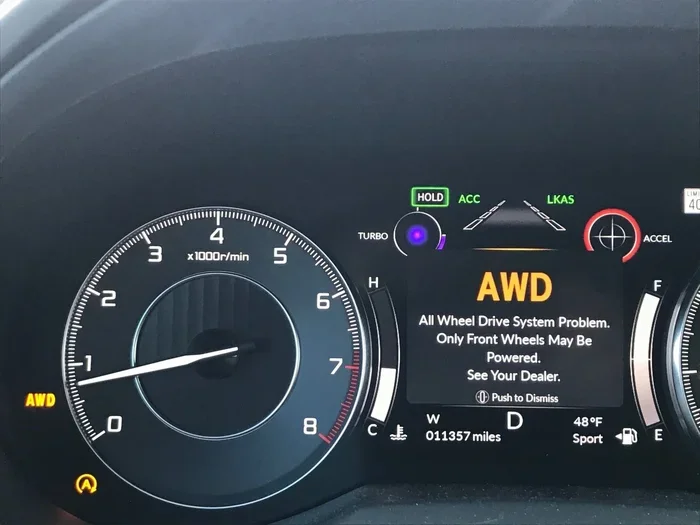
When your dashboard shows an AWD malfunction message, it means the computer has detected a problem in your all-wheel drive system. The car’s AWD module monitors many parts, including sensors, fluid levels, and electrical connections. If anything falls outside the normal range, the system triggers a drivetrain warning.
The warning might show up as a light shaped like a car with wavy lines underneath. It might also read “AWD Fault” or “Check AWD System.” Every car brand displays it a little differently. But the message is the same: something in the all-wheel drive system needs inspection.
Here are some common AWD fault message types you might see:
- AWD Warning Light — a steady or flashing yellow or red light
- Service AWD System — a message on the information display
- AWD Off — the system has disabled itself to protect other parts
- Drivetrain Malfunction — a broader warning that includes AWD issues
Each message tells you a slightly different story. A steady yellow light usually means the issue is not an emergency. A flashing red light, on the other hand, means stop safely and turn off the engine. Knowing which type you have helps you decide what to do next.
How the AWD System Works
To understand the AWD malfunction, it helps to know how the system works. In a standard front-wheel drive car, power goes only to the front wheels. In a rear-wheel drive setup, power goes to the back. An all-wheel drive system splits power between all four wheels using a transfer case and sensors.
The AWD sensor monitors wheel speed, road conditions, and traction. When one wheel starts to slip, the system sends more power to the wheels that grip the road. This is called AWD engagement, and it happens automatically in most modern vehicles.
If a sensor fails, the AWD module cannot make smart decisions about power distribution. That is when the AWD malfunction light comes on. The system may default to front-wheel drive mode, which is safe for short distances but not ideal for long trips or bad weather.
Can You Still Drive When the AWD Light Comes On?
Yes, in most cases you can still drive a short distance when the AWD malfunction light appears. But “short distance” and “safe” are two different things. Let us look at when it is okay and when it is not.
Here is a quick guide to help you decide:
- You can drive carefully if the light is steady yellow, the car drives normally, and you are close to a repair shop.
- You should stop driving if the light is flashing red, you hear grinding noises, or the car pulls to one side.
- Avoid highways and wet roads because the all-wheel drive system may not engage properly when you need it most.
- Keep your speed under 40 mph and avoid sharp turns until you get the car checked.
The key idea is to treat the AWD malfunction as a heads-up, not a death sentence. Your car is telling you, “Hey, check me out soon.” Listen to it, and you can avoid bigger problems down the road.
Short-Distance Driving vs. Long-Distance Driving
Driving five minutes to the nearest mechanic is very different from driving 200 miles on a highway. For a short trip on dry roads at low speeds, a drivetrain warning is usually manageable. Your car will likely default to front-wheel drive mode, which is less efficient but still gets you moving.
For long-distance driving, the risk goes up. The AWD system helps with stability during lane changes, highway merging, and driving in rain. Without it, your car handles more like a front-wheel drive vehicle. On wet or icy roads, this can be dangerous. If you must drive far with an AWD malfunction, drive slowly, keep extra distance between cars, and avoid sudden braking.
Quick Tip: If the AWD malfunction light comes on while you are driving, turn on your hazard lights and head to the nearest safe location. Do not slam on the brakes or make sharp turns.
Common Causes of AWD Malfunction
Understanding what triggers an AWD malfunction helps you act faster. Several things can cause the drivetrain warning to appear. Some are simple fixes. Others need a professional mechanic.
Faulty Wheel Speed Sensors
The wheel speed sensor is one of the most common culprits. Each wheel has a sensor that measures how fast it is spinning. If one sensor fails or gets dirty, the AWD module cannot read the data correctly. This triggers an AWD fault message on your dashboard.
Wheel speed sensors get exposed to road grime, water, and debris over time. A simple cleaning might fix the issue. But if the sensor is damaged, you will need a replacement. The good news is that wheel speed sensor replacement is usually affordable and quick.
Low AWD Fluid or Fluid Leaks
Your all-wheel drive system relies on special fluid to keep everything running smoothly. This fluid lubricates the gears and helps transfer power between the front and rear axles. If you have an AWD fluid leak, the fluid level drops, and the system cannot work properly.
Signs of low AWD fluid include:
- A whining or grinding noise from the drive shaft
- Vibrations when accelerating
- The AWD malfunction light appearing after driving for a while
- Difficulty engaging AWD engagement on slippery surfaces
Check your owner’s manual for the right fluid type. Topping off the fluid might solve the problem if the level is low. But if you notice a leak, get it repaired right away. Driving with low fluid can cause permanent damage to the transfer case and other internal parts.
Bad Transfer Case
The transfer case is the heart of your all-wheel drive system. It takes power from the transmission and splits it between the front and rear axles. Over time, the transfer case can wear out, develop leaks, or fail electronically.
A bad transfer case often causes a grinding noise, especially when switching between front-wheel drive and rear-wheel drive modes. If you ignore it, the AWD malfunction light will stay on, and eventually the car may not move at all. All-wheel drive repair for a transfer case can be expensive, so catching it early is important.
Electrical Issues and Blown Fuses
Modern AWD systems rely heavily on electronics. The AWD module controls everything through sensors, wiring, and fuses. A blown AWD fuse or a loose connector can throw the whole system off.
Before you panic, check the fuse box. Look for the AWD fuse in your owner’s manual. If it is blown, replacing it is cheap and easy. If the fuse keeps blowing, there is likely a deeper electrical problem that needs professional attention.
Differential Issues
The differential allows each wheel to spin at different speeds, which is essential for turning corners. Differential issues can cause the AWD malfunction light to come on. Worn differential gears, low differential fluid, or a damaged drive shaft can all lead to problems.
If you hear a clunking sound when turning or accelerating, get your differentials checked. Catching differential issues early can prevent a much more expensive AWD repair cost later.
What Happens If You Ignore the AWD Warning?
It is tempting to ignore the AWD malfunction light, especially if the car seems to drive fine. But ignoring it is a gamble, and the odds are not in your favor.
Here is what can happen if you keep driving with an unresolved drivetrain warning:
- Increased tire wear — When the all-wheel drive system is not working, your tires wear unevenly. This means you will need new tires sooner.
- Damage to the transfer case — Low fluid or a failing component puts extra stress on the transfer case, leading to costly repairs.
- Loss of traction on wet roads — Without proper AWD engagement, your car handles like a front-wheel drive vehicle in the rain. This increases the risk of accidents.
- Higher AWD repair cost — Small problems become big ones fast. A sensor that costs $50 to replace today could lead to a $1,000 transfer case repair next month.
- Stuck in two-wheel drive mode — The system may permanently disable the AWD function until the problem is fixed, limiting your car’s performance and safety.
Expert Insight: Many drivers tell me they ignored the AWD malfunction light for months. By the time they finally got it checked, the repair bill was three times what it would have been earlier. The AWD system check is cheap. The repairs are not.
AWD Repair Cost: What to Expect
The AWD repair cost depends on what is causing the problem. Here is a rough breakdown:
- Wheel speed sensor replacement: $100 to $300
- AWD fluid change and leak repair: $150 to $400
- Blown fuse or electrical fix: $50 to $150
- Transfer case repair or replacement: $500 to $2,500
- Differential repair: $300 to $1,200
These are ballpark numbers. Your actual cost depends on your car model, where you live, and whether you go to a dealership or an independent shop. Getting a diagnosis first is always the smart move.
How to Diagnose and Fix an AWD Malfunction
If your AWD malfunction light is on, you do not have to guess what is wrong. There are clear steps you can take to diagnose and, in some cases, fix the problem yourself.
Step 1: Check the Dashboard for Other Warnings
Look at your full dashboard. Are there other lights on? If you see the traction control light, the electronic stability control light, or the check engine light along with the AWD warning, the problem might be more widespread. These systems share sensors and wiring, so one issue can trigger multiple warnings.
Step 2: Check the AWD Fluid Level
Pop your hood and locate the AWD fluid reservoir. If the fluid is low, top it off with the correct type listed in your owner’s manual. After refilling, take a short test drive and see if the light goes off. Sometimes low fluid is the only problem.
Step 3: Inspect for Visible Leaks or Damage
Get under the car (safely, with a jack and jack stands) and look for fresh fluid drips, cracked hoses, or damaged wiring. An AWD fluid leak is easy to spot because the fluid is typically red or brown. If you find a leak, you have a clear starting point for repairs.
Step 4: Use an OBD-II Scanner
An OBD-II scanner is one of the best tools for diagnosing an AWD malfunction. You can plug it into the port under your steering column, and it will read the error codes stored in your car’s computer. These codes tell you exactly which sensor or component is failing.
Many auto parts stores offer free OBD-II scanning. You can also buy a basic scanner for under $50 and use it anytime. The codes might point to a faulty wheel speed sensor, a transfer case issue, or an AWD module communication error.
Step 5: Reset the System
After fixing the issue, you may need to reset the AWD malfunction light. Disconnect the car battery for 10 to 15 minutes, then reconnect it. This clears the error codes and resets the drivetrain warning system. If the light comes back on, the problem is not fully fixed yet.
Quick Tip: Never disconnect the battery while the engine is running. Always turn off the ignition and remove the key before working on any electrical connections.
AWD Malfunction: When to See a Mechanic
Some AWD malfunction issues are simple enough to handle at home. But others require a professional touch. Knowing when to seek help saves you time, money, and stress.
You should see a mechanic if:
- The AWD warning light stays on after you check the fluid and fuses
- You hear grinding, clicking, or whining noises from the drivetrain
- The car pulls to one side or handles strangely when the AWD system engages
- You smell burning fluid or see smoke under the car
- The AWD malfunction light comes back after you reset it
- You are not comfortable working under the car or with electrical systems
Even if you think you have the problem figured out, a second opinion from a professional is worth it. A mechanic can run a full AWD system check, inspect the transfer case, test the AWD module, and confirm that everything is working correctly. This is especially important before a long road trip or a winter drive in snowy conditions.
Finding the Right Mechanic for AWD Repairs
Not every mechanic is experienced with all-wheel drive systems. Look for shops that specialize in drivetrain repair or have experience with your car brand. Ask friends for recommendations, read online reviews, and do not be afraid to ask the mechanic about their experience with AWD systems. A good mechanic will explain the problem clearly and give you a fair AWD repair cost estimate before starting any work.
Preventing Future AWD Malfunctions
The best way to deal with an AWD malfunction is to prevent one. Regular maintenance keeps your all-wheel drive system healthy and extends the life of your vehicle.
Here are some easy habits to follow:
- Change AWD fluid on schedule — Check your owner’s manual for the recommended interval, usually every 30,000 to 60,000 miles
- Inspect sensors and wiring — Look for corrosion, dirt, or damage during regular oil changes
- Check fluid levels monthly — Low fluid is one of the easiest problems to prevent
- Drive gently — Avoid sudden acceleration and hard cornering, especially on rough roads
- Address warnings early — Do not wait for the AWD malfunction light to come on. If you notice any unusual noises or handling changes, get it checked right away
Taking care of your all-wheel drive system pays off. You get better fuel economy, smoother handling, and fewer surprise repair bills. Plus, your car is safer on the road, whether it is raining, snowing, or just a regular Tuesday commute.
Conclusion
So, is it OK to drive with an AWD malfunction? The honest answer is: it depends on the situation. A steady yellow light on a dry road, close to a shop? You can drive carefully. A flashing red light, strange noises, or bad weather? Stop and call for help. Your all-wheel drive system is a critical safety feature, and treating an AWD malfunction seriously is the smartest thing you can do.
The most important takeaway is this: do not ignore the warning. Whether it is a simple sensor replacement, a fluid top-off, or a more complex transfer case issue, early action keeps you safe and saves money. Get a proper AWD system check, understand the AWD repair cost upfront, and do not let a small problem turn into a big one.
Your car is trying to tell you something. The AWD malfunction light is its voice. Listen to it, act on it, and you will keep both yourself and your vehicle in great shape for miles to come.
Frequently Asked Questions
How much does it cost to fix an AWD malfunction?
The AWD repair cost varies widely depending on the cause. A simple wheel speed sensor replacement might cost $100 to $300, while a transfer case repair can range from $500 to $2,500. Always get a diagnosis first so you know exactly what you are paying for.
Can I drive on the highway with an AWD malfunction?
It is not recommended. Without a working all-wheel drive system, your car may not handle well during sudden maneuvers or in changing weather. If you must drive on the highway, keep your speed low, stay in the right lane, and head to a repair shop as soon as possible.
What causes the AWD warning light to come on?
The most common causes include faulty wheel speed sensors, low AWD fluid, a blown AWD fuse, a failing transfer case, or differential issues. An OBD-II scanner can help you read the specific error code and narrow down the cause.
Is AWD malfunction covered under warranty?
It depends on your vehicle’s warranty and the cause of the problem. If the AWD malfunction is due to a manufacturing defect, it may be covered. Normal wear and tear, such as low fluid from a slow leak, usually is not. Check with your dealer or warranty provider for specific details.
Can a low battery cause an AWD malfunction?
Yes, in some cases. A weak battery or low voltage can disrupt the AWD module and trigger a drivetrain warning. If you notice the AWD light flickering or coming on when the battery is old, have the battery tested and replaced if needed.
How do I reset the AWD warning light?
You can reset the AWD malfunction light by disconnecting the car battery for 10 to 15 minutes and then reconnecting it. However, this only clears the light temporarily. If the underlying problem is not fixed, the light will come back. Always address the root cause first.