How to Check Oil Percentage in a 2022 Hyundai Tucson
Checking the oil percentage in your 2022 Hyundai Tucson is quick and easy using the dashboard display. The Tucson features a built-in oil life monitoring system that tracks your oil condition in real time. This guide walks you through every step to read, interpret, and respond to your oil percentage readings correctly.
Your 2022 Hyundai Tucson comes packed with smart features that make car ownership simpler. One of the most useful tools is the oil percentage monitoring system. This system keeps track of your engine oil condition and lets you know when it is time for a change. Understanding how to read this display can save you money and keep your engine running strong for years.
Many Tucson owners wonder how to check oil percentage in their vehicle. The process is simpler than most people think. You do not need any special tools or a trip to the mechanic. With just a few button presses on your steering wheel, you can see exactly where your oil life stands. Let us walk through everything you need to know.
Key Takeaways
- Your 2022 Tucson has a digital oil percentage display that shows oil life, not oil level directly.
- You can check oil percentage through the instrument cluster using the steering wheel controls.
- The system uses driving habits and engine conditions to estimate oil life remaining.
- Resetting the oil percentage indicator is necessary after every oil change.
- Regular manual oil level checks with the dipstick add an extra layer of engine protection.
- Ignoring low oil percentage warnings can lead to serious engine damage over time.
- Using the right oil type keeps the monitoring system accurate and your engine running smoothly.
📑 Table of Contents
- Understanding the Oil Percentage System in the 2022 Hyundai Tucson
- Step-by-Step Guide to Check Oil Percentage
- What the Oil Percentage Numbers Mean
- When Should You Change Your Oil?
- Manual Oil Level Check: The Dipstick Method
- Resetting the Oil Percentage After an Oil Change
- Common Mistakes to Avoid When Checking Oil
- Expert Tips for Maintaining Your Tucson’s Oil Health
- Key Takeaways
- Conclusion
Understanding the Oil Percentage System in the 2022 Hyundai Tucson
The 2022 Hyundai Tucson uses an Oil Life Monitoring System (OLMS). This is not the same as a traditional dipstick oil level check. Instead, the system tracks driving conditions, engine temperature, and mileage to estimate how much life your oil has left. It gives you a percentage that tells you when an oil change is approaching.
How the Oil Life Monitor Works
The Tucson’s computer constantly analyzes your driving patterns. It looks at factors like engine temperature, idle time, and driving intensity. Based on these inputs, the system calculates the remaining oil life as a percentage. When the percentage drops to around 15%, your dashboard will remind you that an oil change is due soon.
Here are some key points about how this system operates:
- Adaptive algorithm: The system adjusts its recommendations based on your actual driving conditions.
- Not a direct oil level measurement: It estimates oil quality, not the physical amount of oil in the engine.
- Driven by conditions: Short trips, extreme temperatures, and heavy towing can reduce oil life faster.
- Default reset interval: The system typically resets after 5,000 to 7,500 miles depending on driving conditions.
Step-by-Step Guide to Check Oil Percentage
Now let us get into the practical part. Checking your oil percentage on the 2022 Tucson is straightforward. Follow these steps carefully and you will have your reading in under a minute.
Step 1: Start the Vehicle
Turn the ignition to the “On” position or start the engine. Make sure the vehicle is in Park. The dashboard will light up and the instrument cluster will become active. You do not need to be driving to check the oil percentage.
Step 2: Locate the Steering Wheel Controls
On the left side of the steering wheel, you will find a set of buttons. These control the instrument cluster display. Look for the button with arrows or a menu icon. Press it to scroll through the available display options on your dashboard.
Step 3: Navigate to the Oil Life Display
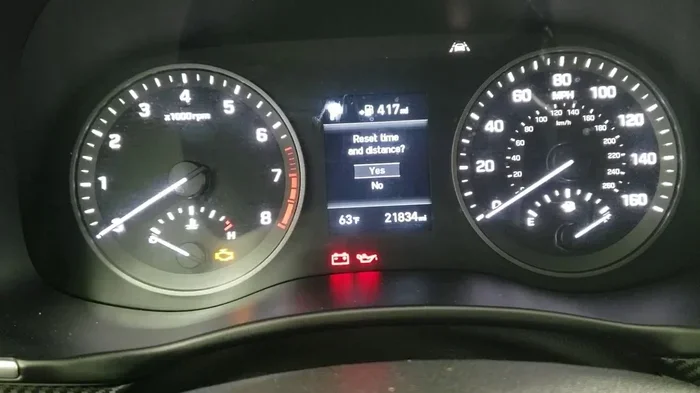
Use the arrow buttons to scroll through the different display modes. You should see options like trip meter, fuel range, and oil life. Keep pressing until you find the oil life percentage screen. It will show a number like 85% or 40%, depending on your current oil condition.
Step 4: Read and Record the Percentage
Take note of the number displayed. If it is above 50%, your oil is still in good shape. If it is below 20%, it is time to plan an oil change. Write it down or take a photo with your phone so you can track changes over time.
Quick Tip: Make it a habit to check your oil percentage every time you fill up with gas. This keeps you aware of your oil condition without any extra effort.
What the Oil Percentage Numbers Mean
The percentage shown on your dashboard represents the estimated remaining life of your engine oil. It is important to understand what these numbers mean for your Tucson.
High Percentage (50% to 100%)
When your oil percentage is above 50%, you are in great shape. The oil is still performing well and protecting your engine. No action is needed at this stage. Continue driving as normal and check again at your next fuel stop.
Medium Percentage (15% to 50%)
A reading between 15% and 50% means the oil is starting to degrade. It is still functional, but you should plan an oil change soon. If you frequently drive in stop-and-go traffic or extreme heat, consider scheduling the service sooner rather than later.
Low Percentage (Below 15%)
When the percentage drops below 15%, the system is telling you that an oil change is overdue. The dashboard will likely also display a maintenance reminder. Do not ignore this warning. Old oil loses its ability to lubricate and protect engine components, which can lead to costly repairs.
When Should You Change Your Oil?
The oil percentage system gives you a good estimate, but it is not the only factor to consider. Several situations call for an oil change even when the percentage is not yet low.
Time-Based Oil Changes
Even if you do not drive many miles, oil degrades over time. Most experts recommend changing oil every 6 months, regardless of the percentage reading. Moisture and contaminants can build up in the oil even during periods of low use.
Driving Conditions That Require More Frequent Changes
Certain driving habits and conditions put extra stress on your oil. Consider changing your oil more often if you experience any of the following:
- Frequent short trips: Short drives under 5 miles do not allow the engine to fully warm up.
- Extreme temperatures: Both very hot and very cold climates strain the oil faster.
- Heavy towing or hauling: Extra weight increases engine load and oil breakdown.
- Dusty or off-road conditions: Particles can contaminate the oil more quickly.
- Stop-and-go city driving: Frequent idling and acceleration cycles wear oil faster.
For more information on oil maintenance, you can read about how mechanics check fluids during an oil change to understand the full scope of fluid maintenance.
Manual Oil Level Check: The Dipstick Method
While the oil percentage system is helpful, it does not replace a traditional dipstick check. The 2022 Tucson may or may not have a visible dipstick depending on the trim level. Some models use an electronic oil level sensor instead. Here is how to check your oil level manually if your vehicle has a dipstick.
How to Use the Dipstick
First, park your Tucson on a level surface. Turn off the engine and wait at least 5 minutes for the oil to settle. Pull the dipstick out, wipe it clean with a paper towel, reinsert it fully, and then pull it out again. Look at the oil marks on the dipstick to see where the level falls between the minimum and maximum markers.
If the level is below the minimum mark, you need to add oil right away. Use the oil type recommended in your owner’s manual. If you are unsure about the right oil, check our guide on oil viscosity differences to understand how oil grades work.
Adding Oil to Your Tucson
If you find that your oil level is low, adding oil is simple. Locate the oil fill cap on top of the engine. Remove the cap, pour in small amounts of the correct oil, and wait a minute before checking the level again. Overfilling can be just as harmful as underfilling, so add oil gradually.
If you are low on oil and need to top off, remember that you can always add oil to your car if it is low as a temporary measure. However, frequent oil top-offs may indicate a leak or burning issue that needs professional attention.
Resetting the Oil Percentage After an Oil Change
After you get your oil changed, you need to reset the oil life monitoring system. This ensures the percentage starts back at 100% and gives you an accurate timeline for your next oil change.
How to Reset the Oil Life System
With the ignition on and the engine off, press and hold the steering wheel buttons until the oil life display starts blinking. Then release the buttons and press and hold them again until the display resets to 100%. This process usually takes about 10 seconds. If you are unsure, your owner’s manual has detailed reset instructions for the 2022 Tucson.
Some owners prefer to have the service center handle the reset. If you take your Tucson to a dealership or mechanic, they can reset the system for you during the oil change service.
Common Mistakes to Avoid When Checking Oil
Even simple tasks like checking oil can lead to mistakes. Here are some common errors Tucson owners make and how to avoid them.
- Checking oil when the engine is hot: Always let the engine cool for a few minutes before using the dipstick. Hot oil can give false readings and may cause burns.
- Ignoring the percentage warning: Some owners see the 15% warning and delay the oil change for weeks. This puts unnecessary wear on your engine.
- Using the wrong oil type: Not all oils are the same. Using the wrong viscosity or formulation can affect how the monitoring system reads oil life.
- Forgetting to reset after an oil change: If you do not reset the system, the old percentage will remain and confuse your maintenance schedule.
- Relying only on the percentage: The percentage estimates oil quality, but it does not tell you the actual oil level. Always do a manual check occasionally.
It is also worth noting that the oil percentage system is different from the check engine light. If your check engine light comes on, that is a separate issue and may not be related to your oil percentage. You can learn more about how the check engine light works in our article on whether a check engine light can turn off on its own.
Expert Tips for Maintaining Your Tucson’s Oil Health
Taking care of your oil is one of the best things you can do for your 2022 Hyundai Tucson. Here are some expert recommendations to keep your engine in top shape.
- Stick to the recommended oil type: Check your owner’s manual for the correct viscosity and specification. Using the factory-recommended oil ensures the monitoring system works accurately.
- Keep a maintenance log: Record every oil change date, mileage, and oil percentage reading. This helps you spot patterns and stay on top of maintenance.
- Inspect for leaks regularly: Look under your vehicle for any oil spots. Early detection of leaks can prevent low oil levels and engine damage.
- Use quality oil filters: A good oil filter keeps contaminants out of your oil and extends its life.
- Do not skip oil changes: Even if the percentage shows plenty of life, time-based oil changes are important for engine longevity.
For owners who also want to keep other fluids in check, learning about what mechanics check during an oil change can give you a broader understanding of your vehicle’s maintenance needs.
Key Takeaways
- Your 2022 Tucson has a digital oil percentage display that shows oil life, not oil level directly.
- You can check oil percentage through the instrument cluster using the steering wheel controls.
- The system uses driving habits and engine conditions to estimate oil life remaining.
- Resetting the oil percentage indicator is necessary after every oil change.
- Regular manual oil level checks with the dipstick add an extra layer of engine protection.
- Ignoring low oil percentage warnings can lead to serious engine damage over time.
- Using the right oil type keeps the monitoring system accurate and your engine running smoothly.
Conclusion
Knowing how to check oil percentage in your 2022 Hyundai Tucson is a simple skill that pays big dividends. The built-in monitoring system makes it easy to stay on top of your oil condition without any guesswork. By following the steps in this guide, you can keep your engine properly maintained and avoid costly repairs down the road.
Remember to combine the digital percentage reading with regular manual checks. Use the right oil, reset the system after every change, and never ignore a low oil warning. Your Tucson will reward you with reliable performance and a long engine life. Take a few minutes today to check your oil percentage. Your future self will thank you when your engine is still running strong at 200,000 miles.
Frequently Asked Questions
Can I check the oil percentage while the engine is running?
Yes, you can check the oil percentage with the engine running or turned off. The display is part of the instrument cluster and is accessible in either state. However, for the most accurate manual dipstick reading, always wait for the engine to cool down first.
What oil does the 2022 Hyundai Tucson use?
The 2022 Tucson typically uses 0W-20 synthetic oil, but you should always check your owner’s manual to confirm. Using the manufacturer-recommended oil ensures the oil life monitoring system works correctly and provides the best engine protection.
How often should I reset the oil life system?
You should reset the oil life system every time you get an oil change. This gives you an accurate starting point for the next oil change interval. The reset process takes less than a minute and can be done at home with the steering wheel controls.
What if my oil percentage drops quickly?
If the oil percentage drops faster than expected, it could indicate a problem. Possible causes include oil leaks, burning oil, or driving in severe conditions. Have your Tucson inspected by a mechanic if you notice a rapid decline in oil life.
Does the oil percentage replace the need for a dipstick check?
No, the oil percentage estimates oil quality but does not measure the actual oil level. You should still perform a manual dipstick check periodically to ensure the oil level is within the safe range on the dipstick markings.
Can low oil percentage damage my engine?
Yes, driving with low oil percentage for extended periods can cause engine damage. Old oil loses its lubricating properties, which increases friction and wear on engine components. Always address a low oil percentage warning promptly to protect your engine.