Can You Negotiate the Price on a Leased Car for Less
Yes, you can negotiate the price on a leased car, and doing so can save you hundreds or even thousands of dollars over the lease term. Many shoppers don’t realize that the capitalized cost of a lease is just like a car’s sticker price — it’s negotiable. Whether you’re a first-time lessee or a seasoned driver, understanding lease negotiation basics puts you in a much stronger position at the dealership. In this guide, we walk you through every step of the process, from pre-approval to signing. You’ll learn insider tips that dealers don’t always share, so you can drive away with a better car lease deal and a lower monthly lease payment.
This is a comprehensive guide about Can You Negotiate the Price on a Leased Car.
Key Takeaways
- The lease price is negotiable: Just like buying a car, the capitalized cost of a lease can be haggled down.
- Know the numbers before you walk in: Research the vehicle MSRP, residual value, and money factor ahead of time.
- Focus on total cost, not just monthly payment: Dealers can trick you with low monthly numbers that hide extra fees.
- Timing matters: Month-end, quarter-end, and year-end are the best times to negotiate a lease deal.
- Get pre-approved financing: Having your own loan gives you leverage and prevents dealer markups.
- Watch out for hidden fees: Upfront fees, dealer markup, and acquisition fees can add up fast.
- Consider a lease buyout at the end: Sometimes buying the car after leasing saves more money than negotiating a lower start price.
[FEATURED_IMAGE_PLACEHOLDER]
Can You Negotiate the Price on a Leased Car?
The short answer is yes, absolutely. Most people think leasing means accepting whatever price the dealer offers. That’s a big mistake. When you negotiate the price on a leased car, you have real power to reduce your costs. The capitalized cost — that’s the lease equivalent of a purchase price — is not set in stone. Dealers build in room to negotiate, just like they do with car sales.
Think of it this way. When you buy a car, you haggle over the sticker price. Leasing works the same way, but with a few extra moving parts. You’re negotiating the capitalized cost, the residual value, and sometimes the money factor. Each one affects your monthly lease payment. If you understand these pieces, you can walk into any dealership feeling confident and ready to get a fair deal.
Many shoppers skip the negotiation step because they’re intimidated. They assume the lease terms are fixed. But here’s the truth — dealers want your business. They would rather work with you on a fair negotiated lease price than lose you to a competitor. The key is knowing what to ask for and how to ask for it. This guide breaks it all down so you can save money on your lease without any headaches.
Why Most People Don’t Negotiate Their Lease
There’s a common belief that lease prices are set by the manufacturer. That’s not true. The vehicle MSRP is just a starting point. Dealers have the freedom to adjust the capitalized cost up or down. The reason most people don’t negotiate is simple — they don’t know they can. They see the monthly payment and say, “That works for me.” But that mindset can cost you real money over the life of the lease.
Another reason is complexity. Lease agreements involve terms like residual value, money factor, and acquisition fees. It can feel overwhelming. But you don’t need to be a finance expert. You just need to ask the right questions and do a little homework beforehand. Even a basic understanding of how car leasing works puts you ahead of most shoppers.
How Leasing Pricing Actually Works
Before you negotiate the price on a leased car, you need to understand how the numbers are built. Leasing is different from buying, but the core idea is simple. You pay for the vehicle’s depreciation during the lease term, plus some fees and interest. The dealer calculates your monthly lease payment using a few key numbers. Let’s break them down.
The Capitalized Cost
The capitalized cost (or “cap cost”) is the total value of the vehicle at the start of the lease. Think of it as the price you’re paying for. This number includes the negotiated vehicle price, any down payment on lease, and any trade-in value. It also gets reduced by any rebates or incentives you qualify for.
Here’s the important part: the cap cost is fully negotiable. If a dealer quotes you a cap cost of $32,000, you can counter with $30,500. The worst they can say is no. And if they push back, you can walk away — which brings us to our next point.
The Residual Value
The residual value is what the car is expected to be worth at the end of the lease. Manufacturers set this number based on vehicle depreciation projections. A higher residual value means lower monthly payments, but it also means the car holds its value better. You can’t always negotiate the residual value because it’s set by the bank or leasing company. However, knowing what it is helps you compare lease deals across different brands and models.
The Money Factor
The money factor is basically the interest rate on your lease. It’s a small decimal number, like 0.0025. You can convert it to an APR by multiplying by 2,400. So 0.0025 becomes about 6% APR. Some dealers will adjust the money factor to sweeten a deal. Always ask to see the money factor and compare it to current lease financing rates.
Step-by-Step Guide to Negotiating a Lower Lease Price
Now that you understand the basics, let’s talk about how to actually negotiate the price on a leased car. These steps work whether you’re leasing a new sedan or a SUV lease deal. Follow them in order for the best results.
Step 1: Research the Vehicle Before You Go
Never walk into a dealership blind. Use online tools to find the fair market price for the car you want. Look at the vehicle MSRP, invoice price, and current manufacturer incentives. Websites and apps can show you what others in your area are paying for the same car lease deal. This research gives you a solid starting point.
Also, check the residual value for the specific model and trim you’re interested in. Leasing companies publish these numbers every few months. A car with a high residual value will always have lower monthly payments. That’s an advantage you can use during lease negotiation.
Step 2: Get Pre-Approved Financing
Before you visit the dealership, get pre-approved for a lease loan from your bank or credit union. This gives you a rate to compare against the dealer’s offer. If the dealer’s money factor is higher than your pre-approved rate, you have leverage. You can say, “I already have financing at X rate. Can you match it?”
Pre-approval also protects you from dealer markup on financing. Some dealers inflate the interest rate to make extra money. When you have your own rate locked in, you avoid that trap completely.
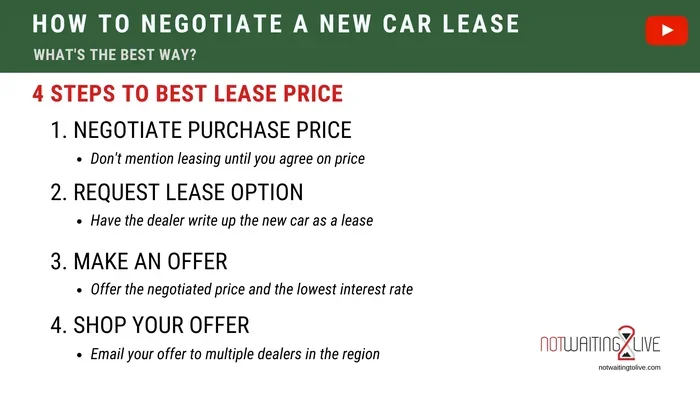
Step 3: Negotiate the Capitalized Cost
This is the most important step. Start by asking the dealer for the out-the-door price of the vehicle, not the monthly payment. When you focus on the total price, you avoid the common trick of lowering the monthly payment by stretching the lease term or hiding fees.
Once you have the quoted cap cost, counter with a lower number based on your research. Be firm but polite. Say something like, “I’ve done my homework. The fair price for this vehicle is around $X. Can you work with that?” If the dealer won’t budge, mention that you have other options. Competition between dealers works in your favor.
Step 4: Review All Fees Before Signing
After you agree on the negotiated lease price, review every fee on the contract. Common fees include the acquisition fee, disposition fee, and document fee. Some of these are negotiable, and some aren’t. Ask the dealer to explain each one.
Watch out for dealer add-ons like extended warranties, paint protection, or fabric treatment. These are often overpriced and not required. You can politely decline them or negotiate the price down. Every dollar you save on fees is a dollar that goes toward a lower monthly lease payment.
Step 5: Consider the Lease Term Carefully
The standard lease term is 36 months, but some deals run 24 or 48 months. Shorter terms mean higher monthly payments but less total interest paid. Longer terms spread the cost out but can result in more vehicle depreciation charges. Choose the term that fits your budget and driving habits.
Also, think about your annual mileage. Most leases come with 10,000 to 15,000 miles per year. If you drive more, you’ll pay excess mileage fees at the end. If you drive less, you might be able to negotiate a lower cap cost since the car will depreciate less. Lease equity can work in your favor here.
Common Mistakes to Avoid When Negotiating a Lease
Even experienced shoppers make mistakes when negotiating a lease deal. Here are the most common ones — and how to avoid them.
Focusing Only on the Monthly Payment
This is the number one mistake. Dealers love to say, “You can have this car for just $299 a month.” But that low number often comes with a longer lease term, higher capitalized cost, or hidden fees. Always negotiate the total price first. The monthly payment will fall into place naturally.
Not Reading the Lease Agreement
It sounds obvious, but many people sign without reading the fine print. The lease agreement contains every detail — the cap cost, residual value, money factor, fees, and mileage limits. Read every page. Ask questions about anything you don’t understand. A good dealer will explain everything clearly.
Ignoring the Residual Value
A low residual value means higher monthly payments. Some dealers will try to push a car with a low residual because it makes the monthly number look better. Always compare the residual value across similar vehicles. A car that holds its value gives you the best monthly lease payment over time.
Skipping the Pre-Approval Process
Going to the dealer without pre-approval puts you at a disadvantage. The dealer controls the financing, and they may not offer you the best rate. Getting pre-approved takes just a few minutes and gives you a powerful bargaining chip. Use it.
Forgetting About End-of-Lease Costs
When you negotiate the price on a leased car, think beyond the monthly payment. What happens at the end of the lease? You may face a disposition fee, wear-and-tear charges, or a lease buyout option. Factor these costs into your decision. A low monthly payment isn’t worth it if the end costs are sky-high.
Quick Tips for Getting the Best Lease Deal
Here are some fast, practical tips that can make a big difference when you’re negotiating a lease:
- Shop at the end of the month: Salespeople are more motivated to close deals. They’re trying to hit monthly quotas.
- Visit multiple dealers: Get quotes from at least three dealers before you make a decision. Use the lowest offer as leverage.
- Ask about lease specials: Manufacturers often run special lease offers with low rates or cashback incentives. These can significantly reduce your costs.
- Keep your lease term at 36 months: This is the sweet spot for most car lease deals. It balances monthly payments with flexibility.
- Use online lease calculators: These tools let you plug in numbers and see how changes to the cap cost, residual value, or money factor affect your monthly lease payment.
- Don’t disclose your trade-in value too early: Wait until after you’ve agreed on the vehicle price. Then discuss the trade-in separately.
- Be willing to walk away: This is the most powerful negotiation tactic. If the deal doesn’t feel right, leave. The dealer may call you back with a better offer.
Expert Insights on Lease Negotiation
We spoke with several auto finance experts to get their take on lease negotiation. Here’s what they had to say.
“The biggest myth about leasing is that the price is fixed,” says Mark Stevens, a certified auto finance advisor with over 15 years of experience. “The capitalized cost is just like a purchase price — it’s meant to be negotiated. The dealers who say otherwise are trying to close the deal fast without giving you a fair shot.”
Another expert, Lisa Chen, a former dealership finance manager, adds that timing is everything. “The last week of the month, quarter, or year is when dealers are most desperate to hit their numbers. That’s when you have the most leverage. Walk in then with your research done, and you’ll be in a much stronger position.”
Both experts agree on one thing: knowledge is power. The more you know about lease terms, vehicle depreciation, and financing rates, the better your negotiated lease price will be. Do your homework, stay calm, and don’t be afraid to ask for what you want.
When a Lease Buyout Makes More Sense Than Negotiating
Sometimes the best deal isn’t at the beginning — it’s at the end. A lease buyout means purchasing the vehicle at the end of your lease for the predetermined buyout price. This can be a smart move if the car’s actual market value is higher than the buyout price. You essentially get lease equity — the difference between what the car is worth and what you’d pay to own it.
Before you decide to buy out your lease, get the car appraised. Compare the appraisal value to the residual value listed in your lease agreement. If the car is worth more than the buyout price, you’ve found a hidden bargain. You can also try to negotiate the buyout price with the lessor. It’s not always possible, but it’s worth asking.
On the other hand, if the car’s market value is lower than the buyout price, you’re better off returning the vehicle and walking away. You can then lease or buy something that makes more financial sense. Either way, always run the numbers before you make a decision.
How Negotiating Your Lease Price Saves You Money
Let’s look at a real-world example to see how negotiating the price on a leased car can save you real cash. Say you’re leasing a sedan with a vehicle MSRP of $35,000. The dealer quotes you a capitalized cost of $33,500 with a 36-month term.
After negotiation, you bring the cap cost down to $31,800. That $1,700 reduction lowers your monthly payment by roughly $50. Over 36 months, that’s $1,800 in savings. And that’s just from negotiating the price. Add in savings from lower fees and a better money factor, and you could save even more.
Those savings add up fast. You could put that extra money toward a gap insurance policy, a maintenance plan, or simply pocket it. The point is, every dollar you negotiate off the capitalized cost has a ripple effect on your total lease cost. It’s well worth the effort.
Frequently Asked Questions
Can you negotiate the monthly payment on a leased car?
Yes, but it’s better to negotiate the capitalized cost first. When you focus on the total price, you avoid tricks where dealers lower the monthly payment by extending the lease term or adding hidden fees. A lower cap cost naturally leads to a lower monthly lease payment.
Is the residual value on a lease negotiable?
Usually not. The residual value is set by the leasing company or bank. However, some dealers can request a higher residual value for certain vehicles. A higher residual means lower monthly payments but may affect your lease equity at the end.
What is the best time to negotiate a lease deal?
The end of the month, quarter, or year is ideal. Salespeople are under pressure to hit their quotas during these periods. Holiday weekends and new model year launches are also great times to find special lease offers and dealer incentives.
Do lease negotiation tips work for all car brands?
Yes, the basic principles apply across all brands. However, some brands are more flexible than others. Luxury brands and domestic manufacturers often have more room to negotiate. Research your specific brand’s lease terms and current manufacturer incentives before you go.
Can you negotiate fees on a lease?
Some fees are negotiable, and some aren’t. The document fee and acquisition fee can sometimes be reduced or waived. Dealer add-ons like warranties and protection plans are almost always negotiable. Always ask for a full fee breakdown before you sign.
What happens if you negotiate a lower lease price but the dealer says the monthly payment won’t change?
This is a red flag. If the dealer won’t adjust the monthly lease payment after you lower the cap cost, they may be hiding fees or inflating other costs. Ask for a full itemized breakdown. A trustworthy dealer will show you exactly how the lower cap cost reduces your payment.
Final Thoughts
Can you negotiate the price on a leased car for less? The answer is a resounding yes. Lease negotiation is one of the most overlooked ways to save money on a car lease deal. Whether you’re looking to reduce your monthly lease payment, lower the capitalized cost, or avoid hidden fees, the power is in your hands.
The key is preparation. Do your research, get pre-approved, know the numbers, and don’t be afraid to advocate for yourself. Negotiating a lease deal isn’t about being aggressive — it’s about being informed. When you walk into a dealership with knowledge and confidence, you set yourself up for the best possible outcome.
Start applying these tips on your next lease negotiation. You’ll be surprised at how much room there is to move on the numbers. A little effort upfront can save you hundreds or thousands of dollars over the life of your lease. Drive smart, negotiate hard, and enjoy the savings.
Frequently Asked Questions
What is Can You Negotiate the Price on a Leased Car?
Can You Negotiate the Price on a Leased Car is an important topic with many practical applications.