How Bugatti Veyron Aerodynamics Really Enhance Speed
The Bugatti Veyron’s aerodynamics are engineered to reduce drag, generate massive downforce, and keep the car stable at extreme speeds. Every curve, vent, and wing component works together to push the car forward while keeping it planted. Understanding these aerodynamic principles reveals why the Veyron remains a benchmark in supercar design.
The Bugatti Veyron is one of the most iconic supercars ever built. Its top speed of over 250 mph stunned the automotive world when it debuted. But what really makes this car so fast? The answer lies in its aerodynamics. Bugatti Veyron aerodynamics are not just about looking sleek. Every single curve, vent, and surface serves a purpose. In this article, we will break down exactly how the Veyron’s aerodynamic design enhances its jaw-dropping speed.
If you have ever wondered what separates a regular car from a supercar, aerodynamics is a huge part of the answer. The way air flows around a vehicle directly impacts its top speed, stability, and fuel efficiency. The Veyron was designed with one goal in mind: go fast, stay stable, and look stunning doing it. Let us dive into the details.
## The Engineering Behind Bugatti Veyron Aerodynamics
### A Design Built from the Ground Up
The Veyron was not just a fast car slapped together with a big engine. Bugatti started with the aerodynamics first. Engineers at Bugatti spent years studying how air moves around vehicles at extreme speeds. They used advanced wind tunnel testing to refine every angle and surface. The result is a shape that slices through the air with remarkable efficiency.
The car’s body was designed to minimize air resistance while maximizing downforce. This is a delicate balance. Too much drag slows the car down. Too little downforce makes it unstable at high speeds. Bugatti solved this problem with a series of clever engineering solutions.
### The Role of the Drag Coefficient
Every car has a drag coefficient. This number measures how easily air flows around the vehicle. A lower number means less resistance. The Bugatti Veyron has a drag coefficient of just 0.41. For a car that weighs over 4,000 pounds, this is impressive. It means the Veyron does not waste energy pushing through thick air.
Compare this to a typical sedan, which might have a drag coefficient of 0.30. The Veyron is larger and boxier, yet it still achieves excellent aerodynamic efficiency. The secret is in the active components that adjust based on driving speed.
### Active Aerodynamics: The Smart Side of Speed
One of the most fascinating aspects of Bugatti Veyron aerodynamics is the use of active components. These parts move or change shape depending on driving conditions. This is not a static design. It is a dynamic system that adapts in real time.
At lower speeds, the car prioritizes cooling and comfort. At higher speeds, it shifts focus to stability and drag reduction. This smart approach gives the Veyron an edge over competitors that use fixed aerodynamic elements.
## How Downforce Keeps the Veyron Grounded
### Understanding Downforce
Downforce is the force that pushes a car down toward the road. It sounds simple, but it is critical at high speeds. Without enough downforce, a car can become airborne or lose traction. The Veyron generates significant downforce thanks to its carefully designed front splitter, rear wing, and diffuser.
Think of it like this. When you stick your hand out of a car window and tilt it slightly, your hand gets pushed down. That is the basic principle of downforce. The Veyron does this on a much larger and more sophisticated scale.
### The Rear Wing: More Than Just Looks
The Veyron’s rear wing is one of its most recognizable features. But it is not just for show. The wing adjusts its angle depending on driving mode. In top speed mode, the wing lies flat to reduce drag. In handling mode, it angles upward to increase downforce.
This active wing adjustment system is controlled by the car’s computer. Sensors monitor speed, steering angle, and acceleration. The wing responds instantly to keep the car stable. It is a brilliant example of how active aerodynamics enhance both speed and safety.
### The Front Splitter and Air Dam
The front of the Veyron also plays a big role in generating downforce. The front splitter directs air over and under the car. This creates a pressure difference that pulls the front end down. The air dam at the bottom of the front bumper helps manage airflow into the engine cooling system.
Together, the front and rear components work as a team. They balance the car’s grip at all speeds. This balance is essential for a vehicle that can exceed 250 mph.
## Drag Reduction and Air Flow Management
### The Flat Underbody and Diffuser
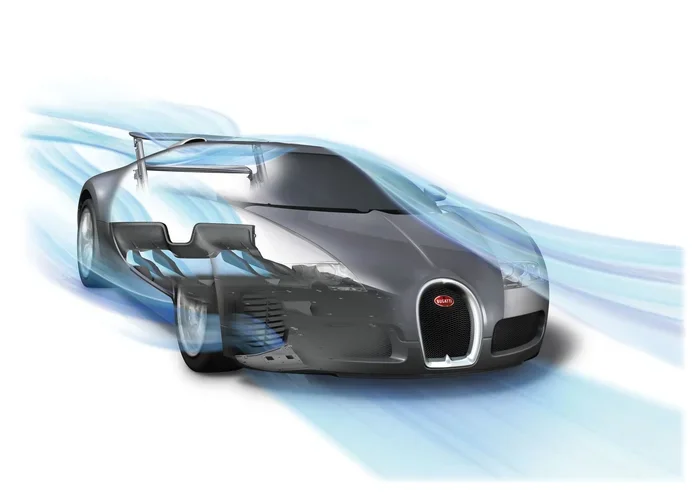
One of the most important elements of Bugatti Veyron aerodynamics is the underbody design. The underside of the car is nearly flat. This smooth surface allows air to flow underneath with minimal turbulence. At the rear, a diffuser gradually widens the space beneath the car.
This widening accelerates the air flowing underneath. According to Bernoulli’s principle, faster-moving air creates lower pressure. The result is a vacuum effect that pulls the car toward the ground. This is how the diffuser generates downforce without adding drag.
### Managing Airflow Through the Body
The Veyron has numerous vents and ducts built into its body. These are not decorative. Each one serves a specific purpose. Hot air from the engine exits through vents on the sides and rear. Cool air is channeled into the engine bay and brakes.
This air flow management system keeps the car’s operating temperatures in check. It also prevents turbulent air from building up around the body. Clean airflow means less drag and better performance.
### How Aerodynamics Impact Top Speed
The Veyron’s top speed of 253 mph was achieved through a combination of raw power and aerodynamic efficiency. The W16 engine produces over 1,000 horsepower. But without proper aerodynamics, all that power would be wasted fighting air resistance.
At extreme speeds, air resistance becomes the biggest enemy. The Veyron’s shape minimizes this resistance. Every millimeter of the body was optimized to let air glide past smoothly. This is why aerodynamic efficiency is just as important as engine power.
## Wind Tunnel Testing and the Engineering Process
### Years of Refinement
Bugatti did not design the Veyron’s aerodynamics overnight. Engineers went through multiple rounds of wind tunnel testing. Each test provided data on airflow patterns, pressure points, and drag forces. They used this data to refine the car’s shape incrementally.
The testing process involved scale models and full-size prototypes. Engineers tested the car at various speeds and angles. They made adjustments to the wing, splitter, and body contours. This iterative process is what gave the Veyron its world-class aerodynamic performance.
### Real-World Testing on Public Roads
Beyond wind tunnels, Bugatti also tested the Veyron on real roads and tracks. This allowed engineers to see how the aerodynamics performed under actual driving conditions. Factors like crosswinds, road surface, and temperature all affect aerodynamic performance.
The real-world testing phase helped Bugatti fine-tune the active systems. They ensured that the wing adjustments and diffuser response felt natural and predictable. This attention to detail is what separates the Veyron from lesser supercars.
## Cooling, Efficiency, and Aerodynamic Design
### The Cooling System Connection
A car with over 1,000 horsepower generates enormous heat. The Veyron’s cooling system relies heavily on aerodynamic design. Large air intakes channel cool air directly to the engine and transmission. Exhaust vents remove hot air efficiently.
Without proper airflow management, the engine would overheat at high speeds. The aerodynamic design ensures that cooling is maintained even during extreme performance driving. This is a perfect example of how car aerodynamics serve multiple purposes beyond just speed.
### Brake Cooling Through Aerodynamics
The Veyron’s carbon-ceramic brakes operate at extremely high temperatures. The aerodynamic design includes dedicated ducts that direct air to the brake discs. This prevents brake fade during hard driving or repeated high-speed runs.
So when you think about Bugatti Veyron aerodynamics, remember that they do more than just push the car forward. They also keep critical components cool and safe.
## Comparing Bugatti Veyron Aerodynamics to Other Supercars
### How Does the Veyron Stack Up?
The automotive world is full of fast cars. How does the Veyron’s aerodynamic design compare to competitors? Let us look at a few key metrics.
| Feature | Bugatti Veyron | Dodge Challenger SRT Hellcat | Ferrari 458 Italia |
|—|—|—|—|
| Top Speed | 253 mph | 203 mph | 202 mph |
| Drag Coefficient | 0.41 | 0.37 | 0.33 |
| Active Aerodynamics | Yes | Limited | Yes |
| Downforce at Top Speed | High | Moderate | High |
| Underbody Diffuser | Yes | No | Yes |
The Veyron’s drag coefficient is higher than some rivals, but its size and weight make this achievement even more impressive. The active aerodynamics give it an advantage in real-world driving situations. While a lighter car like the Ferrari 458 Italia may have a lower drag coefficient, the Veyron’s total speed enhancement is unmatched in its class.
### Why Aerodynamics Matter for Speed Enhancement
If you want your car to go faster, improving aerodynamics is one of the most effective steps you can take. Drag reduction allows the engine to push the car forward more efficiently. Better downforce improves tire grip and cornering stability. Together, these factors create a faster, safer, and more predictable driving experience.
Even if you do not own a Bugatti Veyron, understanding aerodynamics can help you appreciate what makes supercars so special. The next time you see one speeding by, you will know exactly what is keeping it on the road.
## Common Aerodynamic Mistakes Car Owners Should Avoid
### Ignoring Body Damage
Even small dents or damage to a car’s body can disrupt airflow. This increases drag and reduces aerodynamic efficiency. If you notice damage to your vehicle, get it repaired promptly. This applies whether you drive a supercar or a daily commuter.
If you need to manually clear my car codes after bodywork, make sure to check that all sensors are functioning properly. Aerodynamic sensors on modern cars help manage active systems, and damaged components can throw off the balance.
### Overloading the Vehicle
Aerodynamics work best when the car is within its designed weight range. Adding excessive weight changes how air flows around the vehicle. It also reduces the effectiveness of downforce. If you have ever wondered how much weight your car can hold, check your owner’s manual. Staying within limits ensures your car performs as intended.
### Neglecting Aerodynamic Maintenance
The Veyron’s active aerodynamic components require regular maintenance. The wing mechanisms, sensors, and actuators need inspection to function properly. Skipping maintenance can lead to degraded performance and even safety issues at high speeds.
## Expert Insights on Supercar Aerodynamics
### What Engineers Say About the Veyron
Bugatti engineers have spoken publicly about the Veyron’s aerodynamic goals. They wanted to create a car that was stable at any speed. The active systems were designed to make the car feel natural, not mechanical or unpredictable.
One engineer noted that the Veyron’s diffuser alone accounts for a significant portion of its downforce. Another emphasized the importance of the flat underbody in reducing turbulence. These insights show just how deeply aerodynamics influenced every design decision.
### The Future of Aerodynamic Design
The principles used in the Veyron continue to influence modern supercar design. Active aerodynamics are now standard in many high-performance vehicles. Companies are exploring shapes that change in real time using flexible materials and sensors.
The Veyron paved the way for this technology. It proved that aerodynamics and brute force can work together to create something extraordinary.
## Conclusion: Why Bugatti Veyron Aerodynamics Still Matter
The Bugatti Veyron remains a masterpiece of engineering. Its aerodynamic design is a key reason it achieved legendary status in the supercar world. From the active wing to the underbody diffuser, every component works in harmony. The result is a car that is not only incredibly fast but also stable and safe at extreme speeds.
Whether you are a car enthusiast or simply curious about how speed works, the Veyron offers a masterclass in Bugatti Veyron aerodynamics. Understanding these principles gives you a deeper appreciation for the engineering that goes into every supercar on the road today.
The next time you see a Veyron in person or in a video, take a moment to look at its shape. Every line, vent, and curve tells a story of years of engineering focused on one goal: going fast while staying in control. That is the true power of aerodynamics.
Key Takeaways
- Active aerodynamics adjust in real time: The Veyron’s wing and diffuser adapt to driving conditions for optimal speed and stability.
- Drag coefficient matters enormously: A low drag coefficient allows the Veyron to cut through air with minimal resistance at top speed.
- Downforce keeps the car grounded: Without proper downforce, a car like the Veyron would become uncontrollable above 200 mph.
- Underbody airflow is critical: The diffuser and flat underbody work together to accelerate air underneath the car.
- Cooling and aerodynamics overlap: The Veyron uses airflow not just for speed but also to cool its massive engine and brakes.
- Wind tunnel testing shapes every detail: Years of testing refined the Veyron’s shape for maximum aerodynamic efficiency.
Frequently Asked Questions
What is the top speed of the Bugatti Veyron?
The Bugatti Veyron Super Sport has a top speed of 253 mph (407 km/h). This incredible speed is made possible by both its powerful W16 engine and its carefully engineered aerodynamics.
How does the Veyron’s rear wing adjust at high speeds?
The rear wing on the Bugatti Veyron is an active component that adjusts its angle automatically. In top speed mode, the wing lies flat to reduce drag. In handling mode, it angles upward to increase downforce and improve stability.
Why is downforce important for a supercar?
Downforce pushes the car toward the road, increasing tire grip at high speeds. Without sufficient downforce, a supercar like the Veyron would become unstable or even airborne above 200 mph. The aerodynamics generate this force through the splitter, wing, and diffuser working together.
Does the Bugatti Veyron use active aerodynamics?
Yes, the Veyron uses several active aerodynamic systems. These include the adjustable rear wing, the active underbody diffuser, and multiple air vents that open or close based on driving conditions. These systems optimize both speed and stability in real time.
How does aerodynamics affect fuel efficiency in the Veyron?
Better aerodynamic efficiency means the car encounters less air resistance at high speeds. This reduces the engine load and can improve fuel economy slightly. However, the Veyron is a performance-first vehicle, so fuel efficiency is secondary to speed and power.
Can regular car owners benefit from understanding aerodynamics?
Absolutely. Understanding aerodynamics helps car owners make better decisions about maintenance, modifications, and driving habits. Even small changes like removing roof racks or fixing body damage can improve a regular car’s aerodynamic efficiency and fuel economy.