How Does an Ammonia-Fueled Engine Work Simple Breakdown
An ammonia-fueled engine burns ammonia (NH3) as an alternative fuel source instead of gasoline or diesel. The process involves injecting ammonia into the combustion chamber, where it reacts with oxygen to produce energy, nitrogen, and water vapor. This technology offers a promising path toward cleaner transportation with significantly lower carbon emissions.
Have you ever wondered what powers the future of clean transportation? One answer might be hiding in a bottle of household cleaning supplies. Ammonia. That’s right. Ammonia has been turning heads in the automotive world as a potential fuel source for engines. It’s not science fiction anymore. Engineers and researchers are building real engines that run on ammonia, and the results are exciting.
So how does an ammonia-fueled engine actually work? It sounds complex, but the basic idea is surprisingly simple. In this article, we break down everything you need to know. We will walk through the combustion process, explore the benefits, look at the challenges, and peek into what the future holds. Whether you are a car enthusiast or just curious about green technology, this guide has something for you.
Ammonia-powered engines represent one of the most promising developments in alternative fuel technology. They could change how we think about transportation emissions. And the best part? The core science builds on principles you already know from standard internal combustion engines. Let us dive in.
Key Takeaways
- Ammonia engines work similarly to conventional engines: They use internal combustion to convert fuel into mechanical energy, but ammonia replaces traditional petroleum-based fuels.
- Ammonia cracking is a key step: Many designs split ammonia into hydrogen and nitrogen before combustion to improve energy output and engine performance.
- Zero carbon emissions at the tailpipe: The main byproducts are nitrogen and water vapor, making ammonia a compelling option for reducing greenhouse gases.
- Challenges remain: Lower energy density, handling safety concerns, and infrastructure limitations slow widespread adoption of ammonia fuel technology.
- Upgrading your vehicle: Converting a standard engine to run on ammonia is possible, and you can explore how to upgrade your vehicle for alternative fuel compatibility.
- The future looks promising: Major automakers and researchers are investing heavily in ammonia fuel research for both passenger cars and heavy-duty transport.
📑 Table of Contents
- What Is an Ammonia-Fueled Engine?
- How Does the Combustion Process Work?
- What Is Ammonia Cracking and Why Does It Matter?
- Benefits of Ammonia-Fueled Engines
- Challenges and Limitations
- Current Applications and Real-World Examples
- The Future of Ammonia-Fueled Engines
- Common Mistakes to Avoid with Ammonia Engines
- Quick Tips for Understanding Ammonia Engines
- Conclusion
What Is an Ammonia-Fueled Engine?
An ammonia-fueled engine is a type of internal combustion engine that uses ammonia (NH3) as its primary fuel source. Instead of gasoline or diesel, ammonia gets injected into the combustion chamber. There, it reacts with air to create energy that moves the pistons and turns the wheels.
The concept is not entirely new. Scientists have studied ammonia as a fuel for over a century. But recent advances in engine design and emissions control have brought it back into the spotlight. With the world pushing hard to reduce carbon emissions, ammonia offers a unique advantage: it contains no carbon atoms in its molecular structure. That means burning it does not produce carbon dioxide, the primary driver of climate change.
You might be thinking, “Wait, does this mean I can just pour ammonia into my gas tank?” Not quite. Ammonia has very different properties compared to gasoline. It requires specific modifications to work safely and efficiently in an engine. Let us look at exactly what happens inside the engine when ammonia gets burned.
How Ammonia Differs from Traditional Fuels
Ammonia has some unique characteristics that set it apart. First, it has a lower energy density than gasoline or diesel. This means you need more ammonia to produce the same amount of energy. Second, ammonia is harder to ignite. It has a higher auto-ignition temperature, which means the engine needs a little extra help to get the fuel burning.
Third, ammonia is a liquid at relatively low pressure and can be stored and transported similarly to propane. This makes it practical for fuel distribution. Finally, ammonia is corrosive in its pure form. It can damage certain engine components over time, so materials and coatings need special consideration.
How Does the Combustion Process Work?
This is the heart of the matter. Understanding how ammonia burns inside an engine helps you appreciate both its potential and its challenges. The process follows the same general steps as a conventional engine, but with some important twists.
Step 1: Fuel Storage and Delivery
Ammonia is stored in a dedicated tank, much like a gasoline tank. From there, a fuel pump sends ammonia through lines to the engine. The fuel delivery system needs to handle ammonia’s corrosive nature, so specialized materials like stainless steel or certain polymers are used. Some systems also use a small amount of gasoline or diesel as a pilot fuel to help with ignition, since pure ammonia can be tricky to ignite on its own.
Step 2: Ammonia Injection
Once ammonia reaches the engine, it gets injected into the combustion chamber. This happens at precise timing and pressure, controlled by the engine’s computer. The injection system is similar to what you find in modern diesel or gasoline direct-injection engines, but tuned for ammonia’s unique flow characteristics.
If you are curious about how fuel delivery systems work in general, understanding how many fuel pumps a vehicle has can give you useful context. Fuel delivery is a critical part of any engine’s performance.
Step 3: Mixing with Air
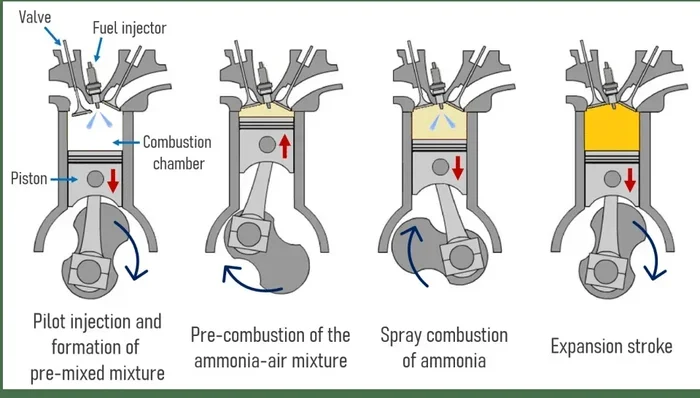
Inside the combustion chamber, ammonia mixes with air. The air-fuel mixture needs to be carefully balanced. Too much ammonia and the engine runs rough or produces excess nitrogen. Too little and you lose power. Modern ammonia engines use sensors and computer controls to maintain the ideal ratio in real time.
Step 4: Ignition and Combustion
Here is where the magic happens. A spark plug (in a spark-ignition design) or compression heat (in a compression-ignition design) ignites the ammonia-air mixture. The combustion reaction breaks down ammonia molecules and releases energy. The primary byproducts are nitrogen gas (N2) and water vapor (H2O). No carbon dioxide. No soot. No particulate matter.
The energy released pushes the pistons down, which turns the crankshaft, which ultimately moves the vehicle. The process is mechanically identical to a gasoline engine. Only the fuel and the chemical reaction differ.
What Is Ammonia Cracking and Why Does It Matter?
Ammonia cracking is one of the most talked-about techniques in ammonia engine research. Here is what it means and why it matters.
Raw ammonia does not burn as efficiently as gasoline or diesel. It has a lower flame speed and lower energy content per unit volume. To solve this, engineers developed ammonia cracking. This process splits ammonia molecules into hydrogen and nitrogen before the fuel enters the combustion chamber.
The hydrogen burns much more efficiently and produces more energy per unit. The nitrogen is released as a harmless byproduct. So you essentially get the best of both worlds: clean combustion and better engine performance.
Cracking can happen through several methods. Thermal cracking uses heat to break ammonia apart. Catalytic cracking uses a catalyst material to speed up the reaction at lower temperatures. Both approaches add complexity and cost to the engine system, but they also improve overall efficiency significantly.
Pros and Cons of Ammonia Cracking
- Pros: Better energy output, improved engine performance, lower nitrogen oxide emissions, and more efficient combustion.
- Cons: Added system complexity, extra weight from cracking equipment, additional cost, and the need for a reliable heat or catalyst source.
The choice between using raw ammonia and cracked ammonia depends on the engine design and intended application. Some engines work well with raw ammonia, especially in stationary power generation. But for vehicles, cracking is often the preferred approach.
Benefits of Ammonia-Fueled Engines
Why are so many researchers and automakers excited about ammonia engines? The benefits are substantial and span environmental, economic, and practical dimensions.
Zero Carbon Emissions
This is the big one. When ammonia burns, it produces nitrogen and water vapor. No carbon dioxide comes out of the tailpipe. In a world racing to cut greenhouse gas emissions, this is a game changer. Ammonia could help decarbonize transportation sectors that are hard to electrify, like shipping, trucking, and heavy machinery.
Existing Infrastructure Potential
Ammonia is already produced in massive quantities worldwide for fertilizers and industrial use. Existing production, storage, and distribution infrastructure can be adapted for fuel use. This gives ammonia a major head start over building entirely new fuel networks from scratch.
High Energy Density by Volume
While ammonia has lower energy density by weight compared to gasoline, it has a higher energy density by volume. This means you can store a meaningful amount of energy in a relatively compact tank. For vehicles where space matters, this is an advantage.
Renewable Production Pathway
Ammonia can be produced from renewable energy sources through a process called green ammonia production. Using solar or wind power to split water into hydrogen, and then combining that hydrogen with nitrogen from the air, creates a fully renewable fuel cycle. No fossil fuels needed at any step.
Challenges and Limitations
Every emerging technology has hurdles, and ammonia engines are no exception. Understanding these challenges gives a balanced picture of where the technology stands today.
Lower Energy Density by Weight
Ammonia contains less energy per kilogram than gasoline or diesel. This means an ammonia-powered vehicle may need larger fuel tanks or more frequent refueling to achieve the same range. For passenger cars, this is a significant consideration. For large trucks and ships, the trade-off may be more acceptable.
Toxicity and Handling Concerns
Ammonia is a toxic gas in its concentrated form. It has a sharp, pungent smell that is easy to detect at low concentrations, which is a safety advantage. But spills or leaks need to be handled carefully. Storage tanks and fuel lines must be designed with robust safety features. Public perception of ammonia as a hazardous chemical also needs to be addressed for widespread adoption.
Nitrogen Oxide Emissions
While ammonia engines produce no carbon dioxide, they can produce nitrogen oxides (NOx) during combustion. NOx contributes to smog and respiratory problems. Modern ammonia engines use selective catalytic reduction (SCR) systems and other after-treatment technologies to reduce NOx emissions to acceptable levels. But managing NOx remains an active area of research and engineering.
Engine Compatibility and Modifications
A standard gasoline or diesel engine cannot run on ammonia without significant modifications. Fuel lines, seals, injectors, and combustion chamber components may all need upgrades. This adds cost and complexity. However, if you are exploring whether your current vehicle could be adapted, learning about what goes into engine compatibility can help. Understanding whether you can put any engine in any car, for instance, gives useful insight into engine swap and conversion considerations.
Limited Refueling Infrastructure
You cannot pull into just any gas station and fill up on ammonia. The refueling infrastructure for ammonia fuel is still in its early stages. Building out this network will require significant investment from governments and private industry. Until the infrastructure catches up, ammonia-powered vehicles will remain a niche option.
Current Applications and Real-World Examples
Ammonia engines are not just theoretical anymore. Several real-world projects and products are moving this technology from the lab to the road.
In the maritime industry, ammonia is being tested as a fuel for large cargo ships. Companies like MAN Energy Solutions are developing two-stroke engines that run on ammonia for ocean-going vessels. These engines could dramatically reduce emissions from global shipping, which currently accounts for about 2 to 3 percent of worldwide carbon emissions.
In the automotive space, several startups and research institutions are developing ammonia-powered passenger vehicles. Some designs use dual-fuel systems where ammonia serves as the primary fuel with a small amount of gasoline for ignition assistance. Others focus on pure ammonia combustion with advanced after-treatment systems.
In stationary power generation, ammonia engines and turbines are already in use in some markets. These applications benefit from the simpler logistics of fixed installations compared to mobile vehicles.
For vehicle maintenance and diagnostics, if you ever need to work on engine systems, knowing how to manually clear car codes can be a useful skill. As ammonia engines become more common, diagnostic tools and procedures will evolve to match their unique requirements.
The Future of Ammonia-Fueled Engines
Where is this technology heading? The outlook is cautiously optimistic. Several trends suggest ammonia could play a meaningful role in the future of clean transportation.
Research funding for ammonia fuel is growing worldwide. Governments in Japan, South Korea, and several European countries have announced national strategies that include ammonia as a key part of their energy transition plans. Automakers are forming partnerships with energy companies to develop both engines and fuel supply chains.
One of the most exciting areas is the development of dual-fuel engines that can switch between ammonia and conventional fuels. This approach offers a practical transition path. Drivers can use ammonia when it is available and fall back to gasoline or diesel when it is not. As the refueling network expands, the reliance on conventional fuels can gradually decrease.
Engine efficiency is also improving. New combustion techniques, better cracking methods, and advanced materials are all pushing ammonia engines closer to the performance and range of conventional vehicles. The gap is narrowing every year.
Looking further ahead, ammonia could become a major player in the broader shift toward sustainable transportation. Combined with electric and hydrogen technologies, ammonia offers a complementary solution for applications where batteries alone may not be practical. The heavy transport sector, in particular, stands to benefit greatly from ammonia’s energy density and storability advantages.
If you are thinking about how alternative fuel options might fit into your vehicle choices, exploring upgrade paths for your current vehicle can be a great starting point. Understanding what it takes to adapt a vehicle for new fuel types helps you make informed decisions about the future of transportation.
Common Mistakes to Avoid with Ammonia Engines
As with any emerging technology, there are some common pitfalls. Here is what to watch out for.
- Assuming ammonia engines need no maintenance: Like any engine, ammonia engines require regular care. Fuel filters, injectors, and after-treatment systems all need attention.
- Ignoring NOx emissions: Just because there is no CO2 does not mean the engine is emission-free. NOx management is critical.
- Overlooking material compatibility: Using standard rubber hoses or seals can lead to corrosion and leaks. Always use ammonia-compatible materials.
- Underestimating infrastructure needs: Running an ammonia vehicle without access to reliable refueling stations limits practicality.
- Skipping the cracking step unnecessarily: If your engine design benefits from cracking, bypassing it will hurt performance and efficiency.
Quick Tips for Understanding Ammonia Engines
- Remember that ammonia (NH3) contains hydrogen and nitrogen but no carbon. This is why it produces no CO2 when burned.
- Think of ammonia cracking as a way to unlock more energy from the fuel before it enters the engine.
- Consider ammonia as a complementary technology, not a replacement for all other clean energy solutions.
- Keep an eye on developments in the maritime and heavy transport sectors. They are leading the way in practical ammonia engine adoption.
- If you are exploring alternative fuels for your vehicle, always consult a qualified mechanic who has experience with fuel system modifications.
Conclusion
Ammonia-fueled engines represent a fascinating and promising frontier in clean transportation technology. They work on familiar internal combustion principles but replace traditional fuels with ammonia to eliminate carbon emissions from the tailpipe. The combustion process, enhanced by techniques like ammonia cracking, converts ammonia into usable energy while producing mostly nitrogen and water vapor as byproducts.
The benefits are clear: zero carbon emissions, potential for renewable production, and compatibility with existing fuel infrastructure. The challenges are real too: lower energy density by weight, toxicity concerns, NOx emissions, and limited refueling networks. But progress is accelerating. With growing investment and research, many of these hurdles are being addressed.
The ammonia engine is not science fiction. It is an emerging reality. Whether you are a car owner curious about alternative fuels or an engineer looking for the next big thing, ammonia deserves your attention. The road to cleaner transportation may just run through a bottle of ammonia.
Stay curious. Stay informed. And keep an eye on this space, because the future of fuel might just smell a little like ammonia.
Frequently Asked Questions
Is ammonia safe to use as a vehicle fuel?
Ammonia is safe when handled properly with appropriate storage and safety systems. It is toxic in concentrated form, but it has a strong odor that makes leaks easy to detect. Modern ammonia fuel systems include multiple safety features like sealed fuel lines, leak detectors, and robust tank designs. Vehicle manufacturers and engineers take these safety considerations very seriously during the design and testing phases.
Can I convert my existing car to run on ammonia?
Converting an existing vehicle to run on ammonia is technically possible but complex. It requires significant modifications to the fuel system, engine components, and emissions controls. The conversion cost can be substantial, and the feasibility depends on your specific vehicle model and engine type. Consulting with a qualified mechanic or alternative fuel specialist is the best first step to evaluate whether your vehicle is a good candidate for conversion.
How does ammonia engine efficiency compare to gasoline engines?
Currently, ammonia engines are generally less efficient than gasoline engines, primarily because ammonia has lower energy density and is harder to ignite. However, technologies like ammonia cracking are closing this gap. As research continues and engine designs improve, efficiency differences are expected to shrink. Some advanced ammonia engines are approaching the efficiency levels of conventional engines in certain operating conditions.
Where can I refuel an ammonia-powered vehicle today?
Refueling infrastructure for ammonia-powered vehicles is still very limited. Most ammonia fuel stations exist for industrial and maritime use rather than passenger vehicles. The development of consumer-facing ammonia refueling stations is an active area of investment and planning. Until the network expands, ammonia vehicles are best suited for regions with established industrial ammonia supply chains or for fleet and commercial applications.
What are the main environmental benefits of ammonia engines?
The biggest environmental benefit is zero carbon dioxide emissions from the tailpipe. Ammonia combustion produces nitrogen and water vapor instead of CO2. When ammonia is produced using renewable energy (green ammonia), the entire fuel cycle can be nearly carbon neutral. Additionally, ammonia engines produce no particulate matter or soot, which improves local air quality in urban areas.
Will ammonia engines replace electric vehicles?
It is unlikely that ammonia engines will fully replace electric vehicles. Instead, they are expected to complement them. Ammonia engines are particularly well-suited for applications where batteries are impractical, such as long-haul trucking, shipping, and heavy machinery. Electric vehicles will likely dominate the passenger car market, while ammonia engines find their strength in sectors that require high energy density and fast refueling.