Can I Drive If My AWD Light Is On and What Happens
Can I drive if my AWD light is on? The short answer is yes, but with caution. When the AWD warning light comes on, it means your all-wheel drive system has detected a problem. Driving short distances to a repair shop is usually safe, but ignoring the light for long can lead to serious drivetrain damage. This guide explains what the light means, why it turns on, and exactly what to do next.
Key Takeaways
- You can drive short distances with the AWD light on, but it is not a long-term solution.
- The AWD light signals a problem in your all-wheel drive system that needs attention.
- Common causes include faulty sensors, low AWD fluid, or a bad transfer case.
- Ignoring the light can lead to costly repairs and unsafe driving conditions.
- A simple diagnostic scan can often reveal the exact issue quickly.
- Replacing a sensor costs much less than repairing a damaged drivetrain.
- Act quickly when the AWD light appears to keep your car running safely.
📑 Table of Contents
What Does the AWD Light Mean?
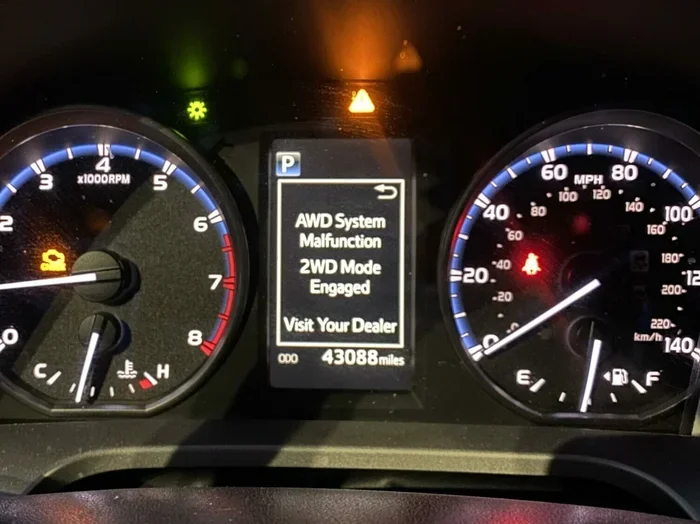
The AWD light on your dashboard is a warning symbol. It tells you that something is wrong with your all-wheel drive system. This light can look different depending on your car. Some vehicles show a simple “AWD” text. Others display a car with all four wheels highlighted. Either way, the message is the same. Your car needs attention.
Your AWD system sends power to all four wheels. This gives you better traction control on wet roads, gravel, or snow. The system relies on sensors, fluid, and electronic parts to work. When one of these parts fails, the light turns on. Think of it as your car saying, “Hey, I need help.”
The AWD warning light is not something you should ignore. But it also does not mean your car will stop working right away. Most cars can still run on two wheels even if the AWD system has a fault. However, driving without proper AWD function can be risky in bad weather.
Understanding what this light means is the first step. The next step is figuring out what to do about it. Let us dive into whether you should keep driving.
Can You Still Drive With the AWD Light On?
The short answer is yes, you can drive with the AWD light on. But there is a big “but.” You should only drive a short distance. The goal is to get to a safe place or a mechanic. Driving long distances with a faulty AWD system can make things worse.
Here is how to think about it. If the light comes on while you are driving on a dry highway, you are probably okay. Your car can run on the rear wheels or front wheels alone. But if you are on a wet road or a icy highway, you need AWD to stay safe. In that case, slow down and find a safe place to stop.
Driving with the AWD light on is like driving with a check engine light. The car still moves. But you are not getting the full performance you should. And if the problem gets worse, you could lose power to the wheels entirely.
When It Is Safe to Keep Driving
You can keep driving if:
- The light just came on and your car feels normal.
- You are on a dry, flat road.
- You are close to a repair shop or your home.
- There are no strange noises or vibrations.
- The light is steady, not flashing.
When You Should Stop Driving
You should pull over if:
- The AWD light is flashing rapidly.
- You hear grinding or clicking sounds from the wheels.
- The car vibrates or pulls to one side.
- You lose power or the car feels sluggish.
- You are driving on a slippery or icy road.
Safety always comes first. If something feels wrong, do not push it. Pull over and call for help if needed.
Common Reasons Your AWD Light Is On
There are many reasons the AWD light might turn on. Some are simple fixes. Others need professional help. Let us look at the most common causes.
Faulty Wheel Speed Sensors
Wheel speed sensors tell your car how fast each wheel is spinning. The electronic control module uses this data to distribute power evenly. When a sensor fails or gets dirty, the system cannot work properly. This is one of the most common reasons the AWD light comes on.
These sensors sit near the wheels and are exposed to road grime. Over time, they wear out or get clogged. A diagnostic scan can tell you exactly which sensor is causing the problem.
Low AWD Fluid
Your AWD system uses special fluid to operate. This fluid keeps the transfer case and differential parts moving smoothly. When the fluid level drops, the system cannot function. The AWD light will turn on to warn you.
Low fluid usually means there is a leak somewhere. You might notice fluid spots under your car. If you check your AWD fluid and it is low, top it off and get the leak fixed right away.
Transfer Case Problems
The transfer case is the heart of your AWD system. It sends power from the engine to both the front and rear wheels. When the transfer case fails, the AWD light comes on. This can happen from wear and tear or from not changing the fluid regularly.
Transfer case repairs can be expensive. That is why catching the problem early matters so much.
Bad Fuse or Wiring Issue
Sometimes the problem is simple. A blown AWD fuse or a loose wire can trigger the light. This is an easy fix for a mechanic. But if you ignore it, the electrical issue can spread to other parts of the system.
Front or Rear Differential Failure
The front differential and rear differential let your wheels spin at different speeds. This is important when you turn corners. If a differential fails, the AWD light will come on. You might also hear a humming or growling noise from the wheels.
Software or Module Glitch
Modern cars rely heavily on computers. The electronic control module manages your AWD system. Sometimes a software glitch or a momentary electrical spike can trigger the light for no real reason. A diagnostic scan will clear this up quickly.
What Happens When You Drive With the AWD Light On?
Driving with the AWD light on for a short time usually will not destroy your car. But driving with it on for weeks or months? That is a different story. Here is what can happen if you keep ignoring the light.
Uneven Tire Wear
When the AWD system is not working correctly, power does not reach all four wheels evenly. This causes your tires to wear down at different rates. You might notice that your front tires are wearing out faster than the rear ones. Uneven tire wear means you will need new tires sooner than expected.
Damage to the Transfer Case
Driving with low AWD fluid or a failing sensor puts extra stress on the transfer case. Over time, this can cause the transfer case to seize up. A seized transfer case means your car cannot switch between two-wheel and four-wheel drive. Repairing or replacing a transfer case can cost hundreds or even thousands of dollars.
Loss of Traction and Control
This is the biggest safety concern. Your AWD system helps you keep control on slippery roads. When the system is off, you lose that advantage. In rain, snow, or ice, your car might slide or spin out. Driving safety should always be your top priority.
More Expensive Repairs Later
A small problem like a bad sensor costs $50 to $200 to fix. But if that sensor causes damage to the differential or transfer case, the bill jumps fast. The longer you wait, the more expensive the repair becomes.
Potential Breakdown
In worst-case scenarios, ignoring the AWD light can lead to a complete system failure. Your car might stop running on the side of the road. This is especially dangerous if it happens in an area with bad weather or no cell service.
How to Fix the AWD Light
Fixing the AWD light starts with finding the root cause. Here is what you can do step by step.
Step 1: Check for Obvious Issues
Open your hood and check the AWD fluid level. Look for any visible leaks or loose wires. Sometimes the fix is as simple as topping off fluid or reconnecting a wire.
Step 2: Get a Diagnostic Scan
Take your car to an auto parts store or mechanic for a diagnostic scan. The scanner reads error codes from your car’s computer. These codes tell you exactly which part is failing. This saves time and money compared to guessing.
Step 3: Replace Faulty Parts
Based on the scan results, replace the bad part. Common fixes include:
- Replacing wheel speed sensors — usually $50 to $200.
- Topping off or replacing AWD fluid — usually $50 to $150.
- Replacing a blown fuse — usually under $10.
- Repairing wiring or connectors — varies by damage.
- Fixing or replacing the transfer case — can cost $500 to $2,000.
Step 4: Reset the Light
After the repair, the light needs to be reset. A mechanic can clear the error codes with a scanner. In some cars, you can disconnect the battery for a few minutes to reset the system. But always check your owner’s manual first.
Step 5: Test Drive
Take a short test drive after the repair. Watch to see if the AWD light stays off. If it does, you are good to go. If it comes back, there might be another issue that needs attention.
Quick Tips
- Always check your AWD fluid at every oil change.
- Do not ignore the AWD light, even if the car seems fine.
- Keep a diagnostic scanner at home if you can.
- Drive carefully and avoid rough roads until the issue is fixed.
- Get a diagnostic scan as soon as the light comes on.
When to See a Mechanic
Some AWD problems you can handle yourself. But others need a professional. Here is when you should see a mechanic.
If the AWD light stays on after you check the fluid and fuses, go to a mechanic. If you hear strange noises from underneath the car, get it looked at. If your car pulls to one side or vibrates while driving, that is a red flag.
The AWD repair cost varies a lot depending on the problem. A sensor replacement is cheap. A transfer case repair is expensive. But the cost of waiting is always higher. A small issue today can become a major repair next month.
Find a mechanic who knows your car brand. A specialist who works on your specific model will diagnose the issue faster. They will also have the right tools and software updates for your vehicle’s computer system.
Can I Drive If My AWD Light Is On: Final Thoughts
So, can I drive if my AWD light is on? Yes, but only for a short distance and with caution. The AWD light is your car telling you something needs attention. Treat it seriously but do not panic.
The best approach is simple. Get the car checked as soon as possible. Do not let the light sit for weeks or months. A quick diagnostic scan can save you from a big repair bill later. And it keeps you safe on the road.
Your all-wheel drive system works hard for you every day. It gives you better grip, better control, and better confidence in tough conditions. Take care of it, and it will take care of you.
Remember, driving safety is not just about the AWD light. It is about listening to your car and acting on its warnings. The next time that light turns on, you will know exactly what to do.
Frequently Asked Questions
Is it safe to drive long distances with the AWD light on?
No, it is not safe to drive long distances with the AWD light on. The AWD system may not be functioning correctly, which can reduce your traction and control. Get the car checked by a mechanic as soon as possible to avoid further damage or unsafe driving conditions.
How much does it cost to fix the AWD light?
The cost depends on the cause. Replacing a wheel speed sensor costs between $50 and $200. Topping off AWD fluid costs around $50 to $150. More serious repairs like a transfer case fix can cost $500 to $2,000. A diagnostic scan usually costs $50 to $100.
Can low AWD fluid cause the AWD light to come on?
Yes, low AWD fluid is one of the most common reasons the AWD light turns on. The fluid is essential for the transfer case and differential to work properly. Check your fluid level regularly and top it off if needed to keep the system running smoothly.
Will the AWD light turn off by itself?
Sometimes the light turns off if the issue is temporary, like a momentary sensor glitch. However, if the underlying problem is not fixed, the light will come back on. Do not assume the problem is gone just because the light is off. Always get a diagnostic scan to confirm.
Can a bad fuse cause the AWD light to come on?
Yes, a blown AWD fuse can trigger the warning light. The fuse controls the electrical circuit for the AWD system. If it blows, the system loses power and the light turns on. Replacing the fuse is usually a quick and inexpensive fix.
What should I do immediately when the AWD light comes on?
First, stay calm and assess your driving conditions. If you are on a dry road, drive carefully to a safe location or mechanic. If you are on a wet or icy road, slow down and pull over if needed. Then schedule a diagnostic scan to identify the exact cause of the warning.
=== CONCLUSION ===
Can I drive if my AWD light is on? Yes, but only as a temporary measure. The AWD light is a clear warning that your all-wheel drive system needs attention. Driving with it on for a short distance is usually fine. But ignoring it for too long can lead to expensive repairs and unsafe driving conditions.
Take action quickly. Check your fluid, get a diagnostic scan, and visit a trusted mechanic. A small fix today can save you from a big headache tomorrow. Your car, your wallet, and your safety will all thank you.