How to Operate a Forklift Step by Step the Right Way
Learning how to operate a forklift step by step is essential for anyone working in warehouses, construction sites, or industrial settings. This guide walks you through every stage of forklift operation, from pre-operation inspections to safe driving techniques and proper load handling. You will gain the knowledge needed to operate a forklift confidently, safely, and in compliance with OSHA standards.
Operating a forklift might look simple from the outside. But once you are behind the wheel, you quickly realize there is a lot more to it than just driving forward and lifting a pallet. Learning how to operate a forklift step by step is the foundation of safe, efficient work in any warehouse or job site.
Every year, thousands of forklift-related injuries happen across the country. Many of these accidents are completely preventable. They happen because operators skip training, ignore inspections, or rush through their tasks. This guide breaks down the entire process into clear, easy-to-follow steps. Whether you are a complete beginner or someone who needs a refresher, you will find practical advice here.
We will cover everything from pre-operation checks to load handling, maneuvering in tight spaces, and shutting down your machine properly. By the end of this article, you will understand what it truly takes to operate a forklift the right way. Let us get started.
Key Takeaways
- Pre-Operation Inspection: Always check your forklift before use to catch mechanical issues early and prevent accidents.
- Proper Training Matters: Forklift certification and hands-on training are non-negotiable for safe and legal operation.
- Load Stability Is Critical: Understanding the stability triangle and center of gravity keeps loads secure during transport.
- Pedestrian Safety Comes First: Awareness of your surroundings protects everyone on the warehouse floor.
- Daily Maintenance Extends Lifespan: Regular upkeep reduces breakdowns and keeps your equipment running smoothly.
- Slow and Steady Wins: Controlled speed and smooth movements prevent tip-overs and load drops.
📑 Table of Contents
- Understanding Your Forklift Before You Start
- Pre-Operation Inspection: Your First and Most Important Step
- Starting the Forklift and Taking Your Seat
- Forklift Safety: The Stability Triangle
- How to Operate a Forklift Step by Step: The Driving Process
- Load Handling: Lifting, Moving, and Placing Pallets
- Forklift Training and Certification Requirements
- Common Mistakes to Avoid
- Daily Maintenance and Post-Operation Care
- Pedestrian Safety and Warehouse Awareness
- Conclusion
Understanding Your Forklift Before You Start
Before you turn the key or touch any controls, you need to know what kind of machine you are working with. Different forklifts have different features, weight limits, and operating characteristics. Taking a few minutes to understand your specific model makes a huge difference.
Types of Forklifts You May Encounter
Not all forklifts are the same. Each type is designed for a specific purpose. Here are the most common types you will see in workplaces:
- Counterbalance Forklift: The most common type. It has weight in the back to balance the load in the front. Great for general warehouse use.
- Reach Truck: Designed for narrow aisles. The forks can extend forward to reach deep into racking systems.
- Pallet Jack: A manual or powered tool for lifting and moving pallets short distances. It is not a full forklift but is worth knowing about.
- Order Picker: Used in warehouses where operators need to pick items from shelves at height.
- Telehandler: A boom lift with forklift capabilities. It reaches higher and farther than standard forklifts.
Knowing your forklift type helps you understand its limits and strengths. Always check the nameplate for the load capacity before you start any job.
Familiarize Yourself with the Controls
Every forklift has a set of controls that you must master. Here is a quick breakdown of the main components:
- Steering Wheel: Controls direction. Forklifts steer from the rear, which feels different from driving a car.
- Gas Pedal (Accelerator): Controls speed. Keep it gentle and gradual.
- Brake Pedal: Slows and stops the machine. Always brake smoothly.
- Parking Brake: Engages when you are stopped or leaving the seat.
- Lift Lever: Raises and lowers the forks. This is one of the most important controls.
- Tilt Lever: Tilts the mast forward or backward. This helps secure loads during transport.
- Horn: Used to alert pedestrians and other operators.
- Seat Belt: Always wear it. It can save your life in a tip-over situation.
Expert Insight: Spend at least 15 minutes familiarizing yourself with every control before your first shift. Muscle memory develops over time, but you need a solid starting point.
Pre-Operation Inspection: Your First and Most Important Step
How to operate a forklift step by step always begins before you even start the engine. The pre-operation inspection is where you catch problems before they become dangerous. Skipping this step is one of the most common mistakes new operators make.
The OSHA-Recommended Pre-Operation Checklist
OSHA requires a daily walk-around inspection for every forklift. Here is a simple checklist you can follow every time:
- Check the tires. Look for flat spots, cracks, or debris lodged in the treads.
- Inspect the forks. Look for cracks, bends, or excessive wear. Damaged forks can fail under load.
- Test the lights and horn. Make sure they work properly. You need these for visibility and communication.
- Check the fluid levels. Look at the hydraulic fluid, engine oil, and coolant.
- Inspect the seat belt. Make sure it retracts properly and locks when pulled.
- Test the brakes. Press the brake pedal and make sure the machine slows down smoothly.
- Check the steering. Turn the wheel left and right. It should move freely without grinding.
- Look for leaks. Check under the forklift for any signs of hydraulic fluid or fuel leaks.
- Verify the data plate. Make sure the load capacity information is visible and legible.
If you find any issue during your inspection, do not operate the forklift. Report it to your supervisor immediately and wait for a replacement machine or repairs.
Quick Tip: Many facilities use a simple tag system. A green tag means the forklift passed inspection. A red tag means it is out of service. Always check the tag before you get in.
Fuel and Battery Safety
Depending on your forklift type, you need to handle fuel or batteries with care. For internal combustion forklifts, check the fuel level and look for any fuel leaks. For electric forklifts, check the battery charge level and make sure the connections are clean and tight. Never smoke near a charging battery. The fumes can be explosive.
Starting the Forklift and Taking Your Seat
Now that your inspection is complete, it is time to start the machine. But there is a specific order you should follow every single time.
Step-by-Step Startup Process
- Walk around the forklift. Do a quick visual check one more time. Look for any new damage or obstacles around the machine.
- Enter from the step side. Always use the three points of contact. Two hands and one foot, or two feet and one hand.
- Sit down and fasten your seat belt. This is not optional. It is a legal requirement and a life-saving habit.
- Press the parking brake. Make sure it is fully engaged before you start the engine.
- Start the engine. Turn the key and listen for any unusual sounds. The engine should start smoothly and idle steadily.
- Check all instruments. Look at the dashboard gauges. Make sure the temperature, oil pressure, and battery levels are in the normal range.
- Test the horn and lights. Give a quick beep and turn on the headlights and taillights.
- Release the parking brake only when you are ready to move. Never release it while still seated if you are not prepared to drive.
Once the forklift is running and all systems look good, you are ready to start moving. But before you do, let us talk about the most important safety concept in forklift operation.
Forklift Safety: The Stability Triangle
Every forklift operator must understand the stability triangle. This is the single most important concept in forklift safety. Without understanding it, you are essentially driving blind.
The stability triangle is an imaginary triangle formed by three points at the base of the forklift. Two points are at the front where the wheels meet the ground, and one point is at the center of the rear axle. As long as the combined center of gravity stays within this triangle, the forklift remains stable.
Here is what can cause the center of gravity to move outside the triangle:
- Carrying a load that is too heavy
- Lifting the load too high
- Tilting the mast forward while moving
- Turning too fast
- Driving on an incline with the load pointed uphill
- Sudden braking or sharp turns
When the center of gravity moves outside the triangle, the forklift tips over. This is the most dangerous type of forklift accident. The best way to prevent it is to keep your loads low, move slowly, and avoid sudden movements.
Expert Insight: Many experienced operators say the golden rule is simple: keep the load low and the speed slow. If you remember nothing else, remember that.
How to Operate a Forklift Step by Step: The Driving Process
This is the core of the guide. Here we break down the actual driving process into clear, actionable steps. Follow these every time you operate a forklift.
Step 1: Adjust Your Seat and Mirrors
Before you move, make sure your seat is in the right position. You should be able to reach all controls comfortably. Adjust your mirrors so you can see behind you. Good visibility is essential for safe forklift operation.
Step 2: Start Moving Slowly
Release the parking brake gently. Press the accelerator lightly. Forklifts accelerate differently than cars. They can lurch forward if you apply too much gas too quickly. Smooth, gradual pressure is the key.
Step 3: Keep the Load Low
Always keep the forks between four and six inches off the ground while driving on level surfaces. This keeps the center of gravity low and the forklift stable. Never raise the load while the machine is in motion.
Step 4: Use the Horn at Intersections
Forklifts are loud, but they are not always loud enough for everyone to hear. Use the horn at every intersection, doorway, and corner. This alerts pedestrians and other operators to your presence.
Step 5: Turn Slowly and Wide
Forklifts turn from the rear. The back end swings wide. Always slow down before a turn. Never turn while raising the forks. This is a leading cause of tip-over accidents.
Step 6: Downgrade with the Load Uphill
When driving on a slope, always keep the load pointed uphill. When going downhill, travel in reverse with the load pointing up the slope. This prevents the load from shifting and causing a loss of balance.
Step 7: Parking and Shutting Down
When you are done, follow these steps to park properly:
- Lower the forks completely to the ground.
- Set the parking brake firmly.
- Neutralize the controls.
- Turn off the engine.
- Remove the key and take it with you.
- Do a final visual check around the forklift.
Common Mistake: Many operators park with the forks still raised. This is dangerous because someone could walk underneath and get injured. Always lower the forks before parking.
Load Handling: Lifting, Moving, and Placing Pallets
Handling loads is where most forklift damage and injuries occur. The way you lift, move, and place a load matters just as much as how you drive.
Lifting a Load
Follow these steps every time you lift a pallet:
- Stop the forklift and engage the parking brake.
- Move the forks about one inch into the pallet entry.
- Lift the forks slightly to clear the floor.
- Tilt the mast backward slightly to secure the load.
- Drive forward slowly to the stacking location.
- Raise the forks to the desired height.
- Tilt the mast forward gently to place the load.
- Lower the forks completely and pull them out of the pallet.
Checking Load Capacity
Every forklift has a maximum load capacity listed on the data plate. Never exceed this number. And remember, the capacity decreases as you lift the load higher and tilt the mast backward. Always check the load weight before you attempt to lift it. If you are unsure, use a scale or ask your supervisor.
Dealing with Unstable Loads
Sometimes loads are not perfectly stacked or balanced. In these situations, use extra caution. Drive even more slowly. Avoid any sudden movements. If the load looks like it might shift or fall, do not move the forklift. Get help to secure the load first.
| Factor | Safe Practice | Risky Practice |
|---|---|---|
| Load Height | Keep low while moving | Raise high during transport |
| Speed | Slow and steady | Fast turns and sudden stops |
| Mast Tilt | Tilt back slightly | Tilt forward while moving |
| Surface | Drive on smooth, level ground | Drive on wet or uneven surfaces |
| Load Weight | Stay under rated capacity | Lift near or over capacity |
Forklift Training and Certification Requirements
You cannot legally operate a forklift without proper training and certification. This is not just a suggestion. It is a federal requirement under OSHA regulations. Let us break down what this means for you.
What Forklift Training Involves
Forklift training has three main parts:
- Classroom Training: You learn about forklift types, safety rules, load capacity, and operating procedures. This is usually done through a training course or online module.
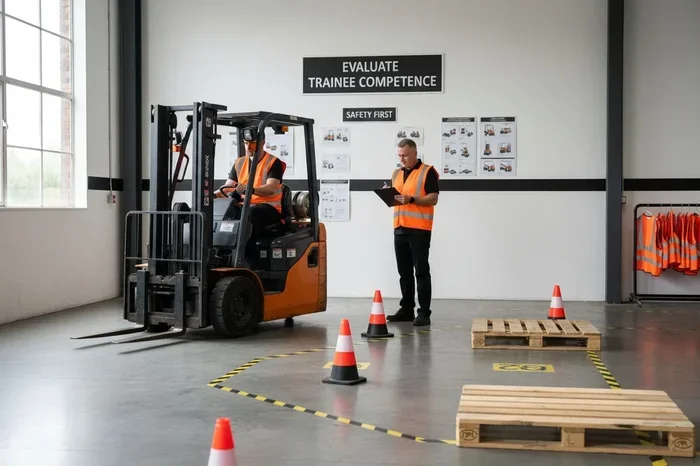
- Practical Training: You get hands-on practice operating the forklift under supervision. You will perform driving tasks, load handling, and inspections.
- Evaluation: You are tested on your knowledge and skills. This includes a written exam and a practical driving test.
How Often Do You Need Refresher Training?
OSHA requires refresher training in three situations:
- Every three years as part of regular evaluation.
- After any forklift accident or near-miss incident.
- When you are observed operating the forklift unsafely.
- When you are assigned to a different type of forklift.
Keeping your certification current is not just about following rules. It is about protecting yourself and everyone around you. The more you practice and review safe practices, the better operator you become.
Common Mistakes to Avoid
Even experienced operators can develop bad habits over time. Here are the most common mistakes and how to avoid them:
- Rushing: Speed is not efficiency. Rushing leads to mistakes, and mistakes lead to accidents. Take your time.
- Raising the load while driving: This raises the center of gravity and makes tip-overs much more likely. Always keep loads low during transport.
- Ignoring the inspection: A quick walk-around takes five minutes. Skipping it can cost you hours of downtime or worse, an injury.
- Not using the seat belt: In a tip-over, the seat belt keeps you inside the protective cage. Without it, you are at serious risk of being crushed.
- Driving with limited visibility: If your load blocks your view, travel in reverse. Never drive forward with a tall load that blocks your vision.
- Overloading the forklift: Just because the forks can lift it does not mean it is safe to move it. Always respect the rated capacity.
Quick Tip: If you are ever unsure about a situation, stop and ask yourself: “Is this safe?” If the answer is no, do not proceed. It is always better to pause than to make a dangerous move.
Daily Maintenance and Post-Operation Care
Taking care of your forklift after each shift extends its life and keeps it safe for the next operator. Here is a simple post-operation routine:
- Clean the forklift. Remove any debris from the forks, mast, and body.
- Check for damage. Look for any new dents, cracks, or leaks that appeared during your shift.
- Report issues. Log any problems in the maintenance tracker so they can be addressed promptly.
- Charge or refuel properly. For electric forklifts, plug in the charger. For fuel-powered forklifts, refuel in a well-ventilated area away from ignition sources.
- Park in the designated area. Never block walkways, exits, or fire equipment.
Good maintenance habits show respect for the equipment and for the people who will use it after you. It also reduces the chance of unexpected breakdowns during your next shift.
Pedestrian Safety and Warehouse Awareness
Forklifts do not operate in a vacuum. You share the workspace with other people. Pedestrian safety is a major part of forklift operation. Here are some important reminders:
- Always assume pedestrians cannot see you.
- Make eye contact with people near your path before moving.
- Use the horn at blind corners and doorways.
- Slow down in areas with heavy foot traffic.
- Never drive toward someone who is standing in your path. Wait for them to move.
- Keep your lights on, even during the day, so others can see you.
Awareness is your best tool. The more you pay attention to your surroundings, the safer everyone is on the floor.
Conclusion
Learning how to operate a forklift step by step is a journey that starts with knowledge and ends with practice. Every step we covered in this guide, from pre-operation inspection to load handling and parking, plays a vital role in keeping you and your coworkers safe. There is no shortcut to becoming a skilled forklift operator. It takes patience, attention to detail, and a genuine commitment to safety.
Remember to always respect the machine you are driving. Follow the training you received. Stay up to date with your certification. And never let complacency creep in. The forklift is a powerful tool, and when used correctly, it makes work faster and easier. When used carelessly, it becomes a serious hazard.
Take what you have learned here and apply it every single time you get behind the wheel. The best forklift operator is not the fastest one. It is the one who shows up prepared, stays alert, and always puts safety first.
Frequently Asked Questions
Do I need a license to operate a forklift?
Yes, you need forklift certification. OSHA requires all forklift operators to complete formal training, practical evaluation, and periodic refresher courses. A valid certification proves you are qualified to operate the equipment safely.
How long does forklift training take?
Most forklift training programs take between one and three days to complete. The classroom portion can be done online, but the hands-on driving evaluation must be completed in person with a certified trainer.
Can I drive a forklift on public roads?
Generally, no. Forklifts are designed for indoor or private property use. If you need to move a forklift on a public road, you must follow specific safety protocols, including proper lighting, registration, and sometimes obtaining special permits.
What causes forklift tip-overs?
Forklift tip-overs are most commonly caused by turning too fast, raising the load too high, exceeding the load capacity, or driving on uneven surfaces. Keeping the load low and moving slowly are the best ways to prevent tip-overs.
How often should I inspect my forklift?
You should perform a pre-operation inspection before every shift. OSHA also requires a thorough annual inspection of all forklifts in the workplace. Regular maintenance between inspections helps keep the equipment in good working condition.
What should I do if the forklift starts to tip over?
Stay in your seat. Do not jump out. Grip the steering wheel tightly, lean away from the direction of the tip-over, and brace your feet firmly on the floor. The seat belt and protective cage are designed to keep you safe during a tip-over event.