How to Fix Reduced Engine Performance in Volvo XC90
Reduced engine performance in a Volvo XC90 is a common issue that can stem from several underlying problems. This guide walks you through the most frequent causes, from clogged air filters to faulty turbochargers, and gives you clear steps to diagnose and fix the issue yourself. You will learn what triggers the warning, which parts to inspect first, and when to call a professional for help.
Your Volvo XC90 is a powerful, well-engineered SUV. But one day, you notice it feels sluggish. The acceleration is slow. The engine seems to struggle. This is what people call reduced engine performance, and it is more common than you might think.
Whether you drive a first-generation XC90 or the latest model, this problem can show up for many reasons. Sometimes it is a simple fix. Other times, it points to a deeper issue. The good news is that most causes are diagnosable and repairable. You do not need to be a mechanic to understand what is going on.
This guide breaks down everything you need to know about fixing reduced engine performance in your Volvo XC90. We will cover the most common causes, the tools you need, step-by-step fixes, and tips to keep your engine running strong. Let us get into it.
Key Takeaways
- Dirty air filters and clogged fuel injectors are the most common culprits behind reduced engine power in the Volvo XC90.
- A failing turbocharger or boost sensor can seriously limit your engine’s output and should be checked early.
- Using an OBD2 scanner helps you read error codes quickly and narrow down the problem without guesswork.
- Regular maintenance like oil changes and spark plug replacements goes a long way in preventing engine performance drops.
- Some fixes are simple DIY jobs, while others require a certified Volvo technician.
- Ignoring the reduced engine power warning can lead to bigger, more expensive repairs down the road.
📑 Table of Contents
- Understanding Reduced Engine Performance in the Volvo XC90
- Common Causes of Reduced Engine Performance in Volvo XC90
- How to Diagnose Reduced Engine Performance
- How to Fix Reduced Engine Performance in Volvo XC90
- Preventing Reduced Engine Performance in the Future
- When to Take Your Volvo XC90 to a Professional
- Final Thoughts
Understanding Reduced Engine Performance in the Volvo XC90
When your dashboard shows a reduced engine power warning, it means your vehicle has entered a protective mode. The engine control unit, or ECU, limits power output to prevent further damage. Think of it as your car’s way of saying, “Something is wrong, and I need to shut down a bit to stay safe.”
The Volvo XC90 uses a sophisticated engine management system. It monitors everything from air intake to fuel delivery to exhaust flow. When one of these systems falls out of range, the ECU triggers the warning light. You might notice a few things happening at the same time:
- The engine feels weak or unresponsive.
- Your top speed drops noticeably.
- Fuel economy gets worse.
- The check engine light comes on alongside the power warning.
These symptoms tell you that something is not right under the hood. The key is to act quickly. The longer you ignore the warning, the more stress you put on other engine parts.
Why Does the Volvo XC90 Enter Reduced Power Mode?
The ECU protects your engine. If it detects a problem it cannot safely handle, it reduces power to keep things from getting worse. Common triggers include sensor failures, airflow restrictions, and fuel system issues. Sometimes a loose wire or a faulty connection is all it takes to set off the warning.
Common Causes of Reduced Engine Performance in Volvo XC90
Let us look at the most frequent reasons your XC90 might be losing power. Each one is different, but they all share one thing in common. They are fixable if you catch them early.
1. Clogged or Dirty Air Filter
Your engine needs clean air to run properly. Over time, the air filter collects dust, dirt, and debris. When it gets too clogged, airflow drops. This starves the engine of oxygen and causes a noticeable loss of power. A dirty air filter is one of the easiest and cheapest problems to fix.
Most Volvo owners should replace their air filter every 15,000 to 30,000 miles. If you drive in dusty areas or do a lot of city driving, you may need to replace it more often. Check your owner’s manual for the exact schedule.
2. Faulty Turbocharger
The Volvo XC90 comes with a turbocharged engine in most trims. The turbocharger forces extra air into the combustion chamber, which boosts power. When the turbo starts to fail, you lose that boost. The result is a significant drop in performance.
Signs of a failing turbocharger include:
- A whining or grinding noise from the engine bay.
- Slow or delayed acceleration.
- Blue or gray smoke from the exhaust.
- The turbo boost pressure warning light on the dashboard.
Turbo issues can range from a simple boost leak to a full turbo replacement. The earlier you catch it, the less expensive the repair will be.
3. Clogged Fuel Injectors
Fuel injectors spray fuel into the engine cylinders at precise intervals. When they get clogged or dirty, the fuel spray becomes uneven. Your engine runs lean, which means it does not get the right fuel-to-air ratio. This causes rough idling, hesitation, and reduced power.
Using low-quality fuel can speed up injector clogging. If you have been filling up at cheaper gas stations, this could be a factor. A fuel system cleaning or injector replacement can restore proper flow.
4. Ignition Coil or Spark Plug Problems
Your engine relies on spark plugs and ignition coils to ignite the fuel-air mixture. When one of these components fails, the engine misfires. A misfire means one or more cylinders are not firing properly. This directly reduces engine power and can damage the catalytic converter over time.
Spark plugs wear out naturally. Most Volvo experts recommend replacing them every 60,000 to 100,000 miles. Ignition coils can fail suddenly and without warning. If you feel a jerking sensation during acceleration, your ignition system is a good place to start looking.
5. Throttle Body Issues
The throttle body controls how much air enters the engine. When it gets dirty or the electronic throttle actuator fails, the engine cannot breathe properly. A stuck or dirty throttle body is a surprisingly common cause of reduced engine power in the XC90.
You might notice rough idling, stalling, or a delayed response when you press the gas pedal. Cleaning the throttle body is often a straightforward fix that does not require a mechanic.
6. Sensor Failures
Modern vehicles rely on dozens of sensors to run efficiently. The Volvo XC90 is no exception. When a sensor like the mass airflow sensor, oxygen sensor, or boost pressure sensor fails, the ECU gets incorrect data. This can trigger the reduced power mode even when nothing else is wrong.
Sensor problems often show up as a check engine light along with the power warning. If you see both lights, scanning for diagnostic codes is the best next step.
How to Diagnose Reduced Engine Performance
Before you start replacing parts, you need to know what is actually wrong. Diagnosing the problem saves you time, money, and frustration. Here is how to approach it step by step.
Step 1: Read the Error Codes
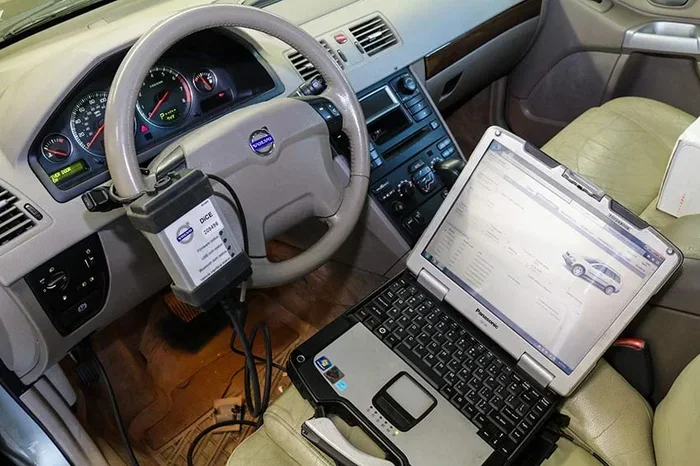
The first thing you should do is plug in an OBD2 scanner. This device connects to your Volvo’s diagnostic port and reads the error codes stored in the ECU. These codes tell you exactly which system or component triggered the warning.
You can buy a basic OBD2 scanner for under $50 at most auto parts stores. Or you can visit an auto parts shop like AutoZone or O’Reilly, and they will often read the codes for free. If you prefer, you can also run diagnostics without a check engine light using certain advanced scanners that access hidden codes.
Common error codes related to reduced engine power in the XC90 include:
- P0299 — Turbocharger boost pressure too low.
- P0171 — System too lean (bank 1).
- P0300 — Random or multiple cylinder misfire detected.
- P0011 — Camshaft position timing issue.
- P0420 — Catalyst system efficiency below threshold.
Write down every code you see. Even if one does not seem related, it could point to a bigger problem when combined with another code.
Step 2: Inspect the Air Filter and Intake System
Pop open your airbox and pull out the air filter. Hold it up to a light. If you cannot see light through it, it is time for a replacement. Also, check the intake hoses for cracks or loose connections. A leak in the intake system lets unfiltered air into the engine, which throws off the air-fuel ratio.
Step 3: Check the Fuel System
Listen for the fuel pump priming when you turn the key to the “on” position (do not start the engine). You should hear a brief humming sound from the rear of the car. If you hear nothing, the fuel pump might be failing. You should also inspect the fuel filter, which is often overlooked but can cause serious power loss when clogged.
Step 4: Look for Boost Leaks
Inspect the rubber hoses and connections between the turbocharger and the intercooler. A small crack or loose clamp can cause a boost leak. This lets compressed air escape before it reaches the engine, which directly reduces power. Boost leaks are a common and often underestimated cause of engine performance drops in turbocharged Volvos.
Step 5: Inspect Spark Plugs and Ignition Coils
Remove the spark plugs and look at them closely. If they are covered in black soot, have a wide gap, or show signs of corrosion, they need replacing. Swap the ignition coils between cylinders and see if the misfire follows the coil. This simple test can pinpoint a bad coil without needing a replacement.
How to Fix Reduced Engine Performance in Volvo XC90
Once you have identified the cause, you can move on to fixing the problem. Some repairs are simple enough to do at home. Others will need a professional touch.
Fix 1: Replace the Air Filter
This is the easiest fix of all. Open the airbox, remove the old filter, and drop in a new one. It takes about five minutes and costs under $30 for a quality replacement filter. Do not forget to close the airbox properly. A loose airbox can cause the same symptoms as a clogged filter.
Fix 2: Clean or Replace the Throttle Body
Remove the throttle body and spray it with throttle body cleaner. Use a soft cloth to wipe away carbon buildup on the throttle plate. Be gentle around the electronic sensor. Once clean, reinstall it and reset the throttle adaptation using an OBD2 tool or by disconnecting the battery for 15 minutes.
Fix 3: Replace Spark Plugs and Ignition Coils
Spark plugs are a routine maintenance item. Remove the old ones, gap the new ones to Volvo specifications, and thread them in by hand to avoid cross-threading. For ignition coils, simply unplug the electrical connector, remove the bolt, and pull the coil out. Install the new one and reconnect.
If you are replacing ignition coils, consider replacing all of them at once. They wear at a similar rate, and replacing only the failed one can leave you coming back for another repair soon.
Fix 4: Repair or Replace the Turbocharger
Turbo repairs are more involved. If you have a boost leak, tightening or replacing the hose clamp might solve the problem. For internal turbo failures, you will likely need a full replacement or rebuild. This is not a DIY job for most people. A qualified Volvo technician can diagnose the exact issue and recommend the right solution.
Fix 5: Clean or Replace Fuel Injectors
For mildly clogged injectors, a fuel system cleaner added to the tank can help. For severe clogs, you will need to remove the injectors and have them professionally cleaned or replaced. Some shops offer ultrasonic cleaning, which is very effective at restoring proper spray patterns.
Fix 6: Replace Faulty Sensors
If a sensor is the root cause, replacing it is usually straightforward. Mass airflow sensors, oxygen sensors, and boost pressure sensors are all accessible on the XC90. Make sure to use OEM-quality replacements or reputable aftermarket parts. Cheap sensors can fail again within a few months.
After replacing any sensor, you should manually clear your car codes using an OBD2 scanner to reset the ECU. This allows the system to relearn and monitor the new component properly.
Preventing Reduced Engine Performance in the Future
The best way to deal with reduced engine performance is to prevent it from happening in the first place. Regular maintenance keeps your Volvo XC90 running at its best and catches small problems before they become big ones.
Here are the most important preventive steps you can take:
- Change your oil on schedule. Clean oil keeps the engine lubricated and prevents buildup that can affect performance.
- Replace the air filter regularly. Do not wait until it looks terrible. Stick to the maintenance schedule in your owner’s manual.
- Use quality fuel. Fill up at reputable stations. Bad fuel can clog injectors and damage engine internals.
- Do not ignore warning lights. If a light comes on, get it checked. A small problem today can become a costly repair tomorrow.
- Keep up with spark plug replacements. Fresh spark plugs ensure consistent combustion and smooth power delivery.
- Check for recalls or service bulletins. Volvo occasionally issues updates for known engine issues. Staying informed can save you from repeat problems.
If you ever notice the check engine light behaving strangely, it is worth investigating further. Sometimes the light might turn off on its own, but the underlying issue remains. Other times, the light stays on and you need to clear it manually. Either way, paying attention to these warnings protects your engine in the long run.
When to Take Your Volvo XC90 to a Professional
Not every repair is a DIY job. Some issues require specialized tools, technical knowledge, or access to Volvo-specific software. You should consider taking your XC90 to a professional if:
- The reduced power warning keeps coming back after you fix it.
- You are getting multiple error codes that do not make sense together.
- The engine is making unusual noises like knocking, grinding, or loud whining.
- You notice significant power loss that affects safe driving.
- The repair involves the turbocharger, fuel system, or engine internals.
A certified Volvo mechanic has access to factory-level diagnostic tools and technical support. They can pinpoint problems faster and often provide warranty coverage on their repairs. If your XC90 is still under warranty, always check with your dealer first before paying for out-of-pocket repairs.
Final Thoughts
Reduced engine performance in a Volvo XC90 is a frustrating but manageable problem. Most causes are common and well-documented. With the right diagnostic approach and a little patience, you can identify the issue and fix it yourself or know exactly what a mechanic needs to do.
Do not let the warning light scare you into inaction. The sooner you address the problem, the less damage it can cause. Start with the simplest fixes like the air filter and spark plugs. Work your way up to more complex issues like the turbocharger or fuel system. And always use quality parts and fluids to keep your XC90 running strong for years to come.
Your Volvo XC90 is a premium vehicle. Treat it with the care it deserves, and it will reward you with reliable, powerful performance every time you get behind the wheel.
Frequently Asked Questions
Can I drive my Volvo XC90 with the reduced engine power light on?
You can drive short distances, but it is not recommended. Reduced power mode limits your engine output, which can be dangerous in traffic or on highways. It also means the ECU has detected a problem that could worsen if ignored. Have the vehicle diagnosed as soon as possible to avoid further damage.
How much does it cost to fix reduced engine performance in a Volvo XC90?
The cost depends entirely on the cause. A new air filter costs around $20 to $40. Spark plugs and ignition coils might run $150 to $400. Turbo replacement can range from $1,500 to $3,500 or more. Always get a proper diagnosis before committing to a repair so you do not pay for unnecessary parts.
What does the check engine light mean on a Volvo XC90?
The check engine light indicates that the ECU has detected an issue in the engine or emissions system. It can be triggered by something as simple as a loose gas cap or as serious as a failing catalytic converter. If the light comes on alongside reduced power, it is important to read the error codes right away.
Can a dirty fuel filter cause reduced engine power?
Yes. A clogged fuel filter restricts fuel flow to the engine. This causes a lean condition where the engine does not get enough fuel relative to air. The result is weak acceleration, rough idling, and a noticeable drop in overall engine performance. Replacing the fuel filter is a quick and inexpensive fix.
How do I reset the reduced engine power warning on my Volvo XC90?
After fixing the underlying issue, you can reset the warning by clearing the error codes with an OBD2 scanner. Simply disconnecting the battery for 15 minutes can also work, but it may reset other settings in your vehicle. If the light comes back after resetting, the problem has not been fully resolved.
Is reduced engine performance the same as engine failure?
No. Reduced engine performance means the ECU has limited power output to protect the engine. It does not mean the engine is about to fail. However, if the underlying cause is not addressed, it can lead to more serious damage over time. Always treat the warning seriously and investigate the root cause promptly.