A Car Accelerates from Rest at a Constant Rate Explained
When a car accelerates from rest at a constant rate, it means the vehicle starts from zero speed and gains velocity evenly over time. This concept is a cornerstone of kinematic motion and helps drivers, engineers, and students understand how cars build speed. You will learn the formulas, real-world examples, and practical tips that make this topic simple and fun to grasp.
Key Takeaways
- Constant acceleration means steady speed gain: A car accelerates from rest at a constant rate when its velocity increases by equal amounts each second.
- Three key formulas govern this motion: The velocity-time, displacement-time, and velocity-displacement equations make solving problems easy.
- Real-world examples are everywhere: From sports cars to buses, many vehicles demonstrate uniform acceleration from a standstill.
- Common mistakes include confusing speed and acceleration: Understanding the difference helps you avoid errors in calculations.
- Engine force and friction play big roles: The net force determines how fast a car picks up speed from rest.
- Graphs make the concept visual: Velocity-time graphs for constant acceleration always form straight lines with a positive slope.
- Practice makes perfect: Working through example problems builds confidence and deepens your understanding of motion physics.
📑 Table of Contents
- What Does It Mean When a Car Accelerates from Rest at a Constant Rate?
- The Science Behind Constant Acceleration
- Key Formulas That Make It Easy
- Real-World Examples of Constant Acceleration in Cars
- Velocity-Time Graphs: Seeing the Motion
- Common Mistakes People Make About Car Acceleration
- Tips for Mastering Constant Acceleration Problems
- Expert Insights on How a Car Accelerates from Rest at a Constant Rate
- Conclusion
What Does It Mean When a Car Accelerates from Rest at a Constant Rate?
You have probably noticed how a car picks up speed when you press the gas pedal. But what happens when a car accelerates from rest at a constant rate? It means the vehicle starts from a complete stop and gains speed in a perfectly even way. Every second, the speed goes up by the same amount. This idea is called uniform acceleration.
Think of it like climbing a staircase. Each step is the same height. You do not skip steps or take tiny half-steps. You just climb one even step after another. That is exactly how a car moves when it accelerates from rest at a constant rate. The speed rises steadily, second after second, without any jumps or dips.
This concept matters more than you might think. It shows up in driver’s ed classes, physics textbooks, and even car commercials. Engineers use it to design engines. Teachers use it to explain motion. Drivers benefit from understanding it too, especially when judging how quickly a car can merge onto a highway.
The beauty of this topic is that it follows simple rules. Once you understand the basics, you can predict where a car will be and how fast it will go at any point in time. Let us break it all down together.
Why Is This Concept So Important?
A car accelerates from rest at a constant rate is one of the first topics students encounter in kinematics. Kinematics is the study of motion without worrying about the forces that cause it. It sets the foundation for more advanced physics later on.
Beyond the classroom, this concept helps in everyday driving. When you pull out from a red light, you are accelerating from rest. If you do it smoothly, you are practicing constant acceleration. Understanding this makes you a better, safer driver.
The Science Behind Constant Acceleration
Now let us dig into the science. When a car accelerates from rest at a constant rate, several physical quantities come into play. Each one tells part of the story.
Initial Velocity and Final Velocity
The car starts from rest. That means the initial velocity is zero. No movement at all. As time passes, the car speeds up. The speed at any later moment is the final velocity. The difference between these two values tells you how much speed the car gained.
Here is a simple way to remember it. Initial velocity is where you start. Final velocity is where you end up. When a car starts from a dead stop, the starting point is always zero.
Acceleration Defined
Acceleration is the rate of change of velocity over time. When a car accelerates from rest at a constant rate, the acceleration value stays the same throughout the entire motion. If the acceleration is 3 meters per second squared, the car gains 3 meters per second of speed every single second.
This steady gain is what makes the motion predictable. You do not need to guess what happens next. The math gives you a clear answer every time.
Displacement and Distance Covered
Displacement is how far the car moves from its starting point. When a car accelerates from rest at a constant rate, the distance it covers grows quickly. In the first second, it covers a small distance. By the third second, it covers much more. This happens because the car is moving faster and faster as time goes on.
This is a key insight. The car does not cover equal distances in equal time intervals. Instead, it covers more and more distance as it picks up speed. That is one of the hallmarks of constant acceleration from rest.
Key Formulas That Make It Easy
You do not need to be a math genius to work with a car accelerates from rest at a constant rate problems. Three simple formulas handle almost everything you will encounter.
Velocity-Time Formula
The first formula connects velocity, acceleration, and time:
v = u + at
Here, v is the final velocity, u is the initial velocity, a is acceleration, and t is time. Since the car starts from rest, u equals zero. This simplifies the formula to v = at. Multiply the acceleration by the time, and you get the final speed. It is that straightforward.
Displacement-Time Formula
The second formula finds how far the car travels:
s = ut + (1/2)at²
Again, u is zero when starting from rest. So the formula becomes s = (1/2)at². You square the time, multiply by half the acceleration, and you have the distance. Notice how time plays a squared role. Double the time, and the distance quadruples. That is why high-speed acceleration feels so dramatic.
Velocity-Displacement Formula
The third formula links velocity and distance without time:
v² = u² + 2as
With u at zero, this becomes v² = 2as. This is handy when you know the distance but not the time. You can find the final speed directly from the acceleration and the distance covered.
Quick Tips for Using These Formulas
- Always check your units. Use meters per second for velocity, meters per second squared for acceleration, and seconds for time.
- Write down what you know first. List the given values before plugging them into any equation.
- Start from rest means u = 0. This simplifies every formula and saves you steps.
- Practice with real numbers. Pick a car with a known acceleration and calculate its speed after 5 seconds. It makes the math feel real.
Real-World Examples of Constant Acceleration in Cars
Theory is great, but seeing a car accelerates from rest at a constant rate in the real world makes it click. Let us look at some practical examples.
Sports Cars and Performance Vehicles
Many sports cars are designed to deliver smooth, consistent acceleration. When a driver floors the throttle, the engine applies a steady force to the wheels. If road conditions are good and the tires grip well, the car can maintain near-constant acceleration from a standstill. Some high-performance vehicles can go from 0 to 60 miles per hour in under 4 seconds using this principle.
Manufacturers often advertise these numbers because they showcase the car’s engine power and transmission efficiency. The smoother and more consistent the acceleration, the better the driving experience feels.
Buses and Trucks at Intersections
Think about a city bus pulling away from a stop. The driver applies steady pressure to the accelerator. The bus starts slow and gradually picks up speed. While not perfectly constant due to traffic and road conditions, the driver tries to maintain a uniform rate of acceleration for passenger comfort.
Heavy trucks work similarly. A loaded truck needs more time to reach a certain speed. The driver applies constant throttle, and the truck accelerates from rest at a steady but slower rate compared to a lighter vehicle.
Electric Vehicles and Instant Torque
Electric cars are interesting cases. They deliver torque instantly from zero RPM. When an EV driver presses the accelerator, the car can maintain a very consistent acceleration from rest. Many electric vehicles provide a smooth, linear increase in speed that closely matches the ideal of constant acceleration.
This is one reason why EVs feel so responsive. The electric motor provides a nearly constant force at low speeds, which translates directly into uniform acceleration from a standstill.
Velocity-Time Graphs: Seeing the Motion
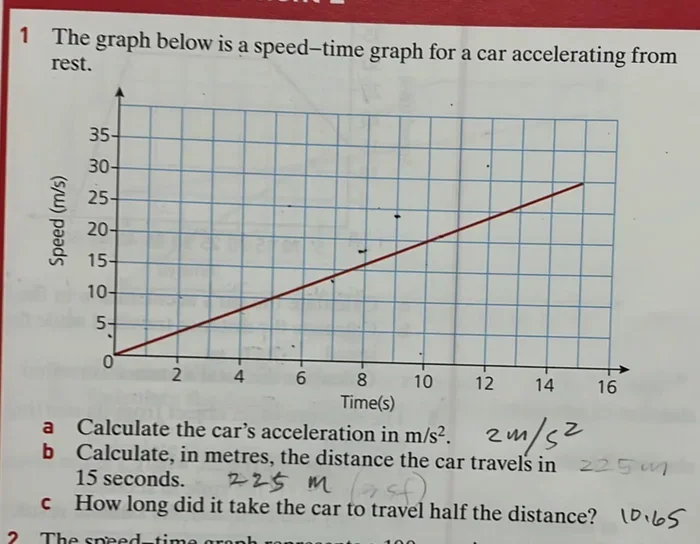
Graphs are one of the best tools for understanding how a car accelerates from rest at a constant rate. A velocity-time graph for this type of motion is always a straight line that starts at zero and slopes upward.
The slope of that line equals the acceleration. A steeper slope means higher acceleration. A flatter slope means slower acceleration. The area under the line gives you the displacement. This visual approach makes abstract formulas much easier to understand.
Try sketching this graph yourself. Draw a horizontal axis for time and a vertical axis for velocity. Start at the origin (zero speed, zero time). Draw a straight line going up and to the right. That line represents a car accelerating from rest at a constant rate. Every point on that line tells you the car’s speed at that exact moment.
What If the Line Is Not Straight?
If the graph curves, the acceleration is not constant. Maybe the driver is easing off the pedal, or maybe friction is slowing things down. A curved line on a velocity-time graph signals changing acceleration. But for our topic, we focus on the straight line because it represents the clean, predictable case of uniform acceleration.
Common Mistakes People Make About Car Acceleration
Even careful students mix up a few concepts when studying how a car accelerates from rest at a constant rate. Here are the most common errors and how to avoid them.
Confusing Speed with Acceleration
Speed tells you how fast something moves. Acceleration tells you how quickly the speed is changing. A car can have high speed but zero acceleration if it is cruising at a steady 60 miles per hour. Conversely, a car at rest can have high acceleration the moment the driver presses the pedal.
Remember: acceleration is about the change, not the current value. A car accelerates from rest at a constant rate means the speed change is steady, not the speed itself.
Forgetting That Rest Means Zero
Many students forget to set the initial velocity to zero. They carry a non-zero value into the formula and get the wrong answer. Always double-check. If the car starts from rest, the initial velocity is zero. No exceptions.
Mixing Up Distance and Displacement
Distance is the total path traveled. Displacement is the straight-line change in position. For a car moving in a straight line from a standstill, these values are the same. But if the car changes direction, they differ. In constant acceleration problems from rest, we almost always deal with straight-line motion, so the two values match.
Ignoring Units
This one trips up everyone at some point. Acceleration is often given in meters per second squared. Time is in seconds. Speed comes out in meters per second. If you mix in kilometers per hour or minutes, your answer will be wrong. Always convert to a consistent unit system before calculating.
Tips for Mastering Constant Acceleration Problems
Getting good at these problems takes practice, but a few strategies can speed up your learning curve dramatically.
Draw a Picture First
Before writing any equation, sketch the situation. Draw the car at the starting line. Show the direction of motion. Mark the known values on the diagram. This simple habit helps you visualize the problem and choose the right formula.
Use the Three Equations as a Toolkit
Think of the three kinematic equations as three different tools. Each one solves a specific type of problem. The velocity-time formula works when you need speed. The displacement-time formula works when you need distance. The velocity-displacement formula works when time is not given. Pick the right tool for the job.
Check Your Answer with Common Sense
After solving a problem, ask yourself: does this make sense? If you calculate that a car reaches 500 meters per second after 5 seconds of constant acceleration, something is wrong. A real car cannot do that. Use everyday experience as a sanity check.
Relate It to Things You Already Know
Connect the physics to real driving. When you merge onto a highway, you are accelerating from rest. When a traffic light turns green and you floor it, you are experiencing constant acceleration (at least for a brief moment). These connections make the abstract math feel tangible and relevant.
Expert Insights on How a Car Accelerates from Rest at a Constant Rate
Physics teachers and automotive engineers often share the same advice when it comes to understanding constant acceleration. They emphasize that the concept is simpler than it looks.
Start with the basics. Do not jump straight into complex problems. Master the idea that constant acceleration means equal speed gains in equal time intervals. Once that clicks, the formulas will feel natural, not forced.
Practice with real cars. Look up the acceleration specs of vehicles you see on the road. A family sedan might accelerate from 0 to 60 in 8 seconds. A sports car might do it in 4 seconds. Compare these numbers and think about what constant acceleration means in each case.
Use graphs liberally. Velocity-time graphs turn algebra into geometry. The slope is acceleration. The area under the curve is distance. Once you see these connections, the entire topic becomes more intuitive and less intimidating.
Experts also point out that friction and air resistance mean real-world acceleration is never perfectly constant. But for learning purposes, the ideal case of constant acceleration gives you a powerful model. You can always add complexity later once the basics are rock solid.
Conclusion
A car accelerates from rest at a constant rate is a foundational concept in both physics and everyday driving. It describes how a vehicle starts from zero and gains speed in a smooth, predictable way. The three key formulas, the velocity-time graph, and the real-world examples all reinforce the same core idea: steady acceleration means steady speed gains.
By understanding this topic, you gain insight into how cars work, how motion is measured, and how to solve practical problems with confidence. Whether you are a student studying for an exam, a driver curious about car performance, or simply someone who loves understanding the world around you, this concept delivers real value.
The key is to keep practicing. Work through example problems. Draw graphs. Check units. Relate the math to the cars you see on the road every day. With time and effort, you will find that analyzing how a car accelerates from rest at a constant rate becomes second nature. Keep exploring, keep learning, and enjoy the journey of understanding motion.
Frequently Asked Questions
What does it mean when a car accelerates from rest at a constant rate?
It means the car starts from a complete stop and gains speed by equal amounts every second. The acceleration value stays the same throughout the motion, making the speed increase perfectly steady and predictable.
What is the formula for a car accelerating from rest at a constant rate?
The main formulas are v = at for final velocity, s = (1/2)at² for distance covered, and v² = 2as for velocity-displacement. Since the car starts from rest, the initial velocity is always zero, which simplifies all three equations.
How far does a car travel when it accelerates from rest at a constant rate?
The distance depends on the acceleration and the time. Use the formula s = (1/2)at². For example, if a car accelerates at 2 m/s² for 10 seconds, it covers 100 meters. The distance grows with the square of the time, so longer acceleration periods cover much more ground.
Can a real car truly accelerate from rest at a constant rate?
In real life, factors like friction, air resistance, and engine limits prevent perfectly constant acceleration. However, many vehicles come close, especially electric cars that deliver smooth, linear power. For physics problems, we use the ideal constant rate model because it simplifies calculations and builds a strong foundation.
What is the difference between acceleration and speed when a car starts from rest?
Speed tells you how fast the car is moving at any given moment. Acceleration tells you how quickly the speed is changing. When a car starts from rest, its initial speed is zero, but its acceleration can be high from the very first instant the driver presses the pedal.
Why do velocity-time graphs for constant acceleration from rest look like straight lines?
A straight line on a velocity-time graph means the velocity changes by the same amount every second. That is exactly what constant acceleration is. The line starts at zero (rest) and slopes upward. The steeper the slope, the greater the acceleration rate.